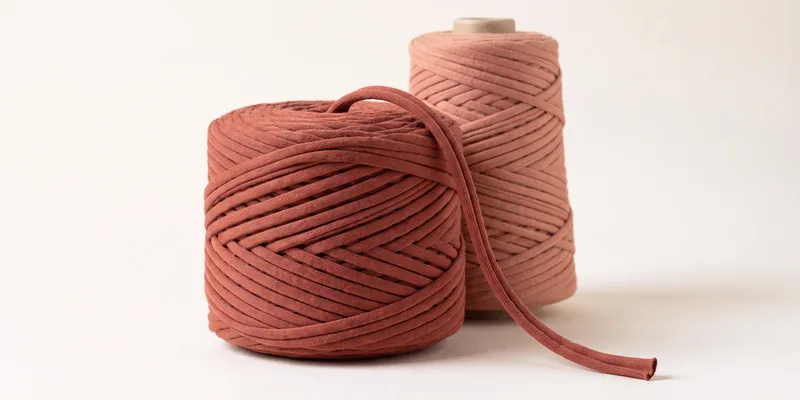
T-shirt yarn has become a go-to material for makers who want big results fast. It is chunky, soft, and forgiving, and a single ball goes a long way. As a manufacturer that works with knit fabric and cordage every day, we get a lot of questions about what it actually is and how to get the best out of it. This guide answers them plainly.
The t-shirt yarn we produce in Jaipur is recycled knit selvedge, 7 to 9 mm in stretch width, on 0.5 to 1 kg cones — see the t-shirt yarn page.
What is t-shirt yarn?
T-shirt yarn is a thick, stretchy yarn made from knit jersey fabric — the same kind of fabric used for t-shirts, which is where the name comes from. Instead of being spun from loose fibres like conventional yarn, it is produced by cutting knit fabric into a continuous strip. Because jersey is a knitted structure, that strip naturally curls in on itself when stretched, forming a rounded, tube-like cord that is comfortable to hold and quick to work.
Most t-shirt yarn is made from cotton or a cotton-rich blend. Cotton gives it a matte, soft handle and good stitch definition, while a small amount of elastane or polyester adds the stretch and curl that make it so easy to crochet. It is much heavier and bulkier than standard knitting yarn, which is exactly why projects grow so quickly.
How is t-shirt yarn made?
There are two broad routes to t-shirt yarn. The home method is to take an old t-shirt, cut it into a continuous spiral strip, and stretch it so the edges roll inward. It works, but the result is short, uneven, and full of seams.
The manufactured version — the kind we produce — starts from knit fabric on the roll or from surplus cuttings generated by garment production. The fabric is slit into even-width strips on dedicated cutting equipment, then wound into balls or cakes under controlled tension so the curl is consistent and the thickness stays uniform along the whole length. Making it from production surplus is also one of the reasons t-shirt yarn is considered a practical, low-waste material: fabric that might otherwise be discarded is turned into something useful.
Key things that separate good t-shirt yarn from rough offcuts are consistent strip width, minimal joins, and a fabric weight that curls cleanly without going stiff. Those are exactly the qualities we control at the cutting and winding stage.
How to use t-shirt yarn
T-shirt yarn is heavy and thick, so it needs the right tools and a slightly different touch than standard yarn.
- Hook and needle size: use a large crochet hook, typically 8mm to 12mm, or chunky knitting needles in a similar range. A hook that is too small will fight you and tire your hands.
- Tension: work a little looser than you would with wool. The yarn has natural stretch, so relaxed, even stitches look best and are kinder on your wrists.
- Joining a new ball: the cleanest method is the "loop join." Cut a small slit near the end of each strip, thread one through the other and pull tight — no knots, no sewing, and the join almost disappears into the work.
- Winding: if your yarn arrives as a cake, pull from the outside to keep it from tangling; wind loose ends into a ball rather than stretching them.
Because it is bulky, t-shirt yarn suits projects where structure and speed matter more than fine detail.
T-shirt yarn crochet: what to make
Crochet is where t-shirt yarn really shines. The most common projects are:
- Baskets and storage bins — the yarn's body helps them hold their shape.
- Rugs and floor mats — round, oval, or rectangular, worked in simple stitches.
- Market and tote bags — strong, stretchy, and quick.
- Plant hangers, cushion covers, coasters, and pet beds.
Single crochet and double crochet in a spiral are the workhorse stitches for baskets and rugs. Because each stitch is large, a beginner can finish a basket in an evening, which is a big part of the appeal. If you want to see the colours and weights we cut, take a look at our t-shirt yarn product page.
How much t-shirt yarn do I need?
Yardage depends on stitch, tension, hook size, and yarn thickness, so treat these as working estimates rather than exact figures. A useful rule: bigger hooks and looser tension use less yarn for the same area.
| Project | Approx. size | Rough yarn needed |
|---|---|---|
| Small basket | 15 cm wide | 50–80 m |
| Medium basket | 25 cm wide | 100–150 m |
| Round rug | 60 cm diameter | 200–300 m |
| Round rug | 90 cm diameter | 450–600 m |
| Market bag | Standard tote | 120–180 m |
When in doubt, buy a little extra of the same dye lot so colours match, since t-shirt yarn shades can vary between production runs.
Buying t-shirt yarn wholesale
For shops, studios, and craft brands, consistency across a full order matters more than any single ball. As a manufacturer we cut to your chosen fabric weight and colours, wind to a specified ball size, and keep strip width uniform across the run. Our standard minimum order is 1,000 m per SKU, and we can advise on the right fabric weight for baskets versus rugs. If you have a project or a colour card in mind, request a quote and we will work out weights, shades, and packing with you.
Frequently asked questions
Is t-shirt yarn the same as jersey yarn?
Yes, the terms are used interchangeably. Both describe yarn cut from knit jersey fabric — the stretchy material used for t-shirts. It may also be called fabric yarn or cloth yarn depending on the region.
What hook size should I use for t-shirt yarn?
Most crafters use a large crochet hook between 8mm and 12mm. The exact size depends on the yarn's thickness and how tight you crochet. A bigger hook keeps the work loose, which is easier on your hands and shows the stitches better.
How much t-shirt yarn do I need for a basket?
A small basket around 15 cm wide typically needs 50 to 80 metres, while a medium basket around 25 cm wide needs roughly 100 to 150 metres. These are estimates; tension and hook size change the total, so keep a little extra of the same colour.
Is t-shirt yarn good for beginners?
Very much so. It is thick and forgiving, uneven stitches are hard to notice, and projects finish fast, which keeps beginners motivated. Simple single or double crochet is enough to make baskets, rugs, and bags.