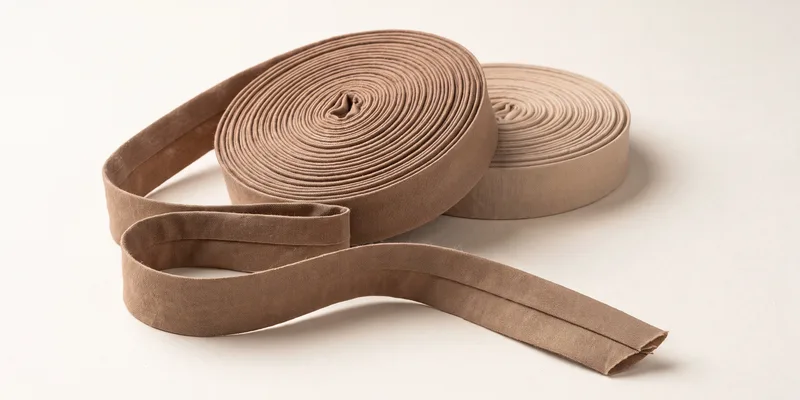
The binding is the last thing you sew on a quilt and the first thing that wears out. It takes the abuse — the edge that gets gripped, dragged off the bed, folded, and washed hundreds of times. Getting the binding right is what separates a quilt that stays sound for years from one that frays at the corners early in its life. This is where bias tape earns its place.
For binding in bulk, our bias tape page covers the single-fold and double-fold tape we make in Jaipur, cut to your width, from 1,000 m per width and shade.
We make cotton bias tape on the factory floor every day, so this guide is written from the maker's side of the table: what the tape actually is, how to choose width and fold, and how much you need for a real project.
What bias tape does on a quilt
A quilt is three layers — top, batting, backing — quilted together. After trimming, those three layers end in a raw, exposed edge. Binding is a strip of fabric folded over that edge and stitched down, sealing all three layers inside a clean finished border. Bias tape is simply that strip, pre-cut and pre-folded, so you skip the cutting, piecing, and pressing.
The word "bias" is the important part. It refers to the direction the strip is cut relative to the weave of the cloth, and it changes how the tape behaves.
Bias grain vs straight grain — why it matters
Woven fabric has two straight grains: the lengthwise (parallel to the selvage) and the crosswise (across the width). The true bias runs at 45 degrees to both. A strip cut on that 45-degree line has stretch and give; a strip cut on the straight grain is stable and stiff.
For binding, that difference decides whether your corners behave:
| Property | Bias-grain tape | Straight-grain tape |
|---|---|---|
| Stretch / ease | Yes — moulds around shapes | Minimal — wants to stay straight |
| Curved & rounded edges | Wraps smoothly, no puckering | Pleats and buckles on curves |
| Straight edges | Works well | Works well, very economical |
| Wear resistance | Thread crosses the fold at an angle, spreading wear | A single thread line sits along the fold |
| Fabric used | More (diagonal cutting) | Less |
The practical rule: if your quilt has any curved edge, scalloped border, or rounded corner, use bias tape — nothing else follows the curve cleanly. On a plain square quilt with straight sides, straight-grain binding is a valid, thrifty option, but many quilters still prefer bias because the diagonal weave spreads wear across the fold instead of concentrating it on one line of threads. That is the reason a bias-bound edge tends to outlast a straight-grain one.
Single fold vs double fold
This is the choice people get stuck on. Both start as a flat strip; the difference is how many layers end up over the edge.
Single-fold bias tape has both long raw edges pressed in toward the centre, leaving one layer of fabric on each face of the quilt edge. It is thinner and lighter. Use it for lightweight items, edges that will be topstitched down, appliqué, and decorative trim where you do not need heavy durability.
Double-fold bias tape is single-fold tape folded once more down the middle, so the strip already forms a channel with two layers of fabric wrapping over the edge. This is the workhorse binding for quilts. The doubled fabric over the edge is exactly where the quilt takes the most handling, so two layers there noticeably extends the life of the binding.
For a bed quilt, throw, or anything that will be washed and used, choose double fold. Reserve single fold for lighter, more decorative finishes.
Choosing the width
Bias tape is sold by its finished width — how wide it looks on the quilt after it is sewn — while the flat cut strip is wider before folding. A wider binding reads as a bolder frame; a narrower one is subtle.
- Narrow (about 6 mm / 1/4 inch finished): a fine, understated edge. Good for small pieces, table runners, and delicate work.
- Standard (about 10–12 mm / 3/8–1/2 inch finished): the everyday quilt binding. Enough width to grip and wrap thicker batting comfortably.
- Wide (13 mm / 1/2 inch and up): a deliberate, framed border, or for very thick, high-loft quilts that need more tape to reach around the loft.
Match the width to the thickness of your quilt sandwich. A high-loft batting needs a wider binding so the fold can travel over the loft and still catch fabric on the back. If in doubt, a standard double-fold width handles most cotton quilts. You can see the widths and cotton constructions we produce on the bias tape product page.
How much bias tape does a quilt need?
Measure the full perimeter of the finished quilt — add up all four sides — then add extra for turning the corners and joining the ends. A reliable working figure is:
Perimeter + 25 to 30 cm (about 10 to 12 inches) of overage.
The overage covers the four mitred corners and the seam where the binding start and finish meet. As a quick reference, a common single-bed quilt roughly 150 × 220 cm has a perimeter of about 7.4 m, so you would buy around 7.7 m of tape. Always round up and keep a little spare — running short 30 cm from the finish line is the classic binding heartbreak.
A material note from the factory
Fibre matters as much as fold. Cotton bias tape presses crisply, holds a fold, and softens with washing to match a cotton quilt — it ages the same way the quilt does. It also takes a needle without fighting back, so hand-finishing the back edge stays comfortable. That consistency across a run is the part we control on the floor, and it is why binding from a single dependable batch behaves the same corner after corner.
If you are binding a production run or a large batch and want to confirm width, fold, and quantity for your specific quilt sizes, request a quote and tell us the dimensions — we will work the metreage with you. Our standard minimum is 1,000 m per SKU.
Frequently asked questions
Do I have to use bias tape, or can I use straight-grain binding for a quilt?
Both work on a quilt with straight edges. Use bias tape whenever the quilt has curves, scallops, or rounded corners, because only bias grain stretches to follow a curve without puckering. Many quilters prefer bias even on square quilts because the diagonal weave spreads wear across the fold and lasts longer.
Is single fold or double fold better for quilt binding?
For a bed quilt, throw, or anything that gets washed and used, double fold is the standard. The two layers of fabric wrapping over the edge sit exactly where the quilt takes the most handling, so the binding lasts far longer. Single fold is lighter and better suited to decorative trim and edges you topstitch down.
How much bias tape do I need for a quilt?
Measure the full perimeter of the finished quilt (add all four sides), then add about 25 to 30 cm extra for the corners and the joining seam. Always round up and keep a little spare, since running short near the finish means re-piecing the binding.
What width of bias tape should I choose?
Around 10 to 12 mm finished width suits most everyday cotton quilts. Go narrower (about 6 mm) for small or delicate pieces, and wider (13 mm and up) for high-loft or thick quilts where the fold needs to travel over more batting to catch fabric on the back.