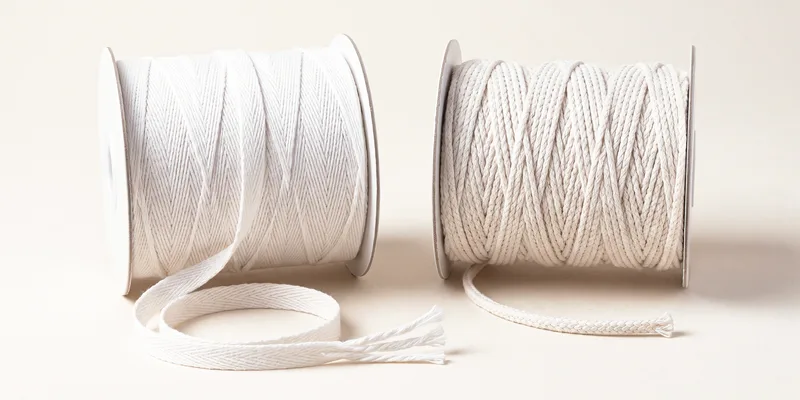
Get the wick size right and a candle burns clean, edge to edge, with a steady flame. Get it wrong and you either drown the flame in a pool of wax or scorch the glass and throw soot. For a cordage and braided-textile manufacturer, wick sits close to our core craft: a candle wick is simply a tightly engineered braid of cotton (sometimes with a paper or cotton core) whose job is to pull melted wax up to the flame at a controlled rate. This guide gives you a working starting chart, then shows how wax type and container shape move you up or down a size.
Our Jaipur factory braids and twists the wick itself — flat, square, round or twisted cotton, sized by ply count; rolls and minimums are on the candle wick page.
What "wick size" actually controls
A wick works by capillary action: the braid draws liquid wax up into the flame, where it vaporises and burns. A bigger, more loosely constructed wick pulls more fuel and makes a larger, hotter flame; a smaller, tighter wick pulls less. Your goal is a full melt pool — liquid wax reaching the container wall — within roughly two to four hours, without the flame growing tall, flickering or mushrooming. Too small a wick tunnels (wax left clinging to the sides). Too large a wick overheats the container, smokes and burns the candle down too fast.
Candle wick size chart by container diameter
Diameter is your first decision, not fragrance or colour. Measure the inside width of the container. This chart is a starting point for a single centred wick using medium-hard wax; always burn-test before scaling up.
| Container diameter | Braided cotton wick (starting size) | Notes |
|---|---|---|
| Under 50 mm (2") | Small / fine flat braid | Tea lights, votives, samplers |
| 50–65 mm (2–2.5") | Small–medium flat braid | Most standard tumblers |
| 65–80 mm (2.5–3") | Medium flat braid | Classic jar candle size |
| 80–100 mm (3–4") | Large flat braid or cored wick | Watch for edge tunnelling |
| 100 mm+ (4"+) | Consider multiple wicks | Two or three wicks spaced evenly |
Once a container passes roughly 100 mm, a single wick struggles to reach the wall before the flame gets unsafe. Two or three smaller wicks, spaced evenly, give a cleaner, more even pool than one oversized wick.
How wax type changes the wick you need
Two candles of the same width can need different wicks purely because of the wax. Denser, higher-melting-point waxes resist flowing, so they generally want a larger or hotter-running wick to open a full pool.
Best wick for soy wax
Soy is a soft, lower-melt-point wax that pools readily, but it can be prone to tunnelling and "wet spots" if under-wicked. For soy, a flat braided cotton wick is a common, reliable starting point — and many makers size one step up from what a paraffin chart suggests to guarantee the pool reaches the wall. Fragrance load and dye also thicken the wax and can call for a slightly larger wick.
Soy and beeswax wick size
Beeswax is the densest of the common natural waxes with a high melt point, so it is the most demanding to wick. A beeswax candle almost always needs a larger wick than a soy or paraffin candle of the same diameter — often one to two sizes up — and blends of soy and beeswax fall in between. If you blend, test at the actual ratio you plan to sell; a 70/30 soy-beeswax pour behaves differently from pure soy.
Paraffin and blends
Paraffin flows easily and is what most legacy sizing charts were built around, so it typically needs the smallest wick of the three for a given diameter. Coconut and parasoy blends sit near soy. Whatever the base, colour pigment and heavy fragrance oils both raise viscosity and nudge you toward a larger wick.
How long should a candle wick be?
Before every burn, trim the wick to about 5–6 mm (roughly a quarter inch). This is the single most important habit for a clean candle. A too-long wick produces a tall, flickering, smoky flame and carbon "mushrooming" on the tip; trimming keeps the flame small, stable and soot-free. For the initial pour and setup, leave enough wick above the wax to light comfortably, then trim down before the first burn. Always let the candle form a full melt pool on that first burn so it sets a clean memory ring.
A simple burn-test routine
No chart replaces testing your exact wax, fragrance, dye and container together. Pour identical candles with wicks one size apart. Burn each for three to four hours and check: Did the pool reach the wall? Is the flame calm and under ~40 mm tall? Any soot on the glass? Is the container comfortable to touch, not too hot? The wick that gives a full pool with the calmest flame wins. Re-test whenever you change wax, fragrance percentage or jar.
Sourcing wick for production runs
Consistency between spools matters as much as the size itself — a braid that varies in tightness will change your burn from batch to batch. We manufacture braided cotton wick to defined constructions so the capillary behaviour stays predictable across large orders. If you are moving from bench testing into repeatable production, see our candle wick range for the braid types and sizes, and request a quote with your container diameter, wax type and monthly volume so we can point you to the right construction. Our standard minimum order is 1,000 m per SKU.
Start from the diameter chart, adjust up for soy and especially beeswax, trim to a quarter inch before every burn, and confirm with a real burn test. That sequence turns wick selection from guesswork into a repeatable spec.
Frequently asked questions
How do I choose a candle wick size?
Start with the inside diameter of your container and match it to a starting wick size, then adjust for wax type. Denser waxes like beeswax need a larger wick, while paraffin needs the smallest. Always confirm with a burn test using your exact wax, fragrance and jar, because dye and fragrance load also affect the result.
What is the best wick for soy wax?
A flat braided cotton wick is a common, dependable choice for soy. Because soy pools easily but can tunnel if under-wicked, many makers size one step up from a paraffin chart to be sure the melt pool reaches the container wall. Heavier fragrance and dye loads may call for a slightly larger wick again.
Does beeswax need a bigger wick than soy?
Yes. Beeswax is denser with a higher melt point, so it is the hardest of the common waxes to wick and usually needs a wick one to two sizes larger than soy or paraffin at the same diameter. Soy-beeswax blends sit in between, so test at the exact ratio you plan to use.
How long should a candle wick be before burning?
Trim the wick to about 5 to 6 mm, roughly a quarter inch, before every burn. This keeps the flame small, steady and soot-free and prevents the tall, smoky flame and carbon mushrooming that come from an over-long wick. Also let the first burn form a full melt pool to set a clean memory ring.