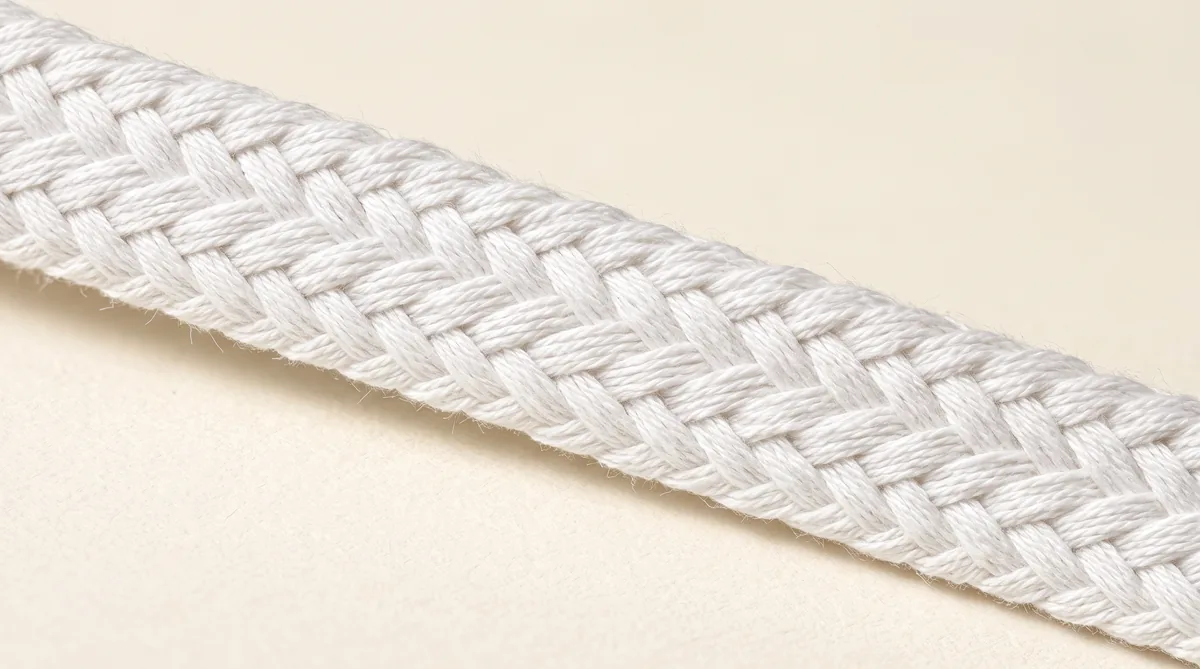
Every candle problem a maker brings us — tunnelling, mushrooming, drowning, smoking — traces back to the same decision: which wick construction, at which thickness, in which wax. The wax gets the attention; the wick does the work. This guide covers the four constructions we actually braid and twist at our factory in Jaipur, what each one does in a flame, and how professional makers size them.
We sell all four as raw, unwaxed rolls, with a 1,000 m minimum per braid and ply count; the specifications are on the cotton candle wick page.
The four constructions
Flat braid curls and self-trims in container candles; square braid stands straight for hot beeswax; round braid carries a pillar's wider flame; twisted burns fastest for small candles. The four side by side:
| Construction | Cross-section | Best candle / wax | Burn behaviour |
|---|---|---|---|
| Flat braid | Woven flat, ribbon-like | Container candles — soy, paraffin | Tip curls into the flame and self-trims; least mushrooming |
| Square braid | Square, stands straight | Beeswax and hot-throw candles | Holds posture in thick, hot melt pools |
| Round braid | Rounded, carries more fibre | Pillars and wider diameters | Feeds a bigger flame without drowning |
| Twisted | Plied cotton, twisted (no braid) | Birthday candles, diyas, votives | Fastest-burning, least rigid, most economical |
Flat braid is the workhorse of container candles. The braid is woven flat like a ribbon, and as it burns the tip curls sideways into the hottest part of the flame, where the excess is consumed. That curl is self-trimming behaviour — less mushrooming, less carbon build-up, fewer trimming complaints from your customers.
Square braid reads square in cross-section and stands straighter in the melt pool. It was developed for beeswax, which burns hotter and more slowly than paraffin or soy, and it holds its posture in thick, viscous pools where a flat braid would flop. If your line is beeswax or heavily-fragranced hot-throw candles, square braid is where testing usually lands.
Round braid carries more fibre in the same diameter — more body, more fuel delivery. Pillar candles and wider diameters use it because the flame needs to throw a wider melt pool without drowning.
Twisted wick is the simplest construction: plied cotton, twisted, no braid. It burns faster and holds less rigidity, which is exactly right for birthday candles, diyas and small votives where the candle is finished before rigidity matters. It is also the most economical, which matters at festival volumes.
How wick sizing actually works
Thickness is written as ply count — how many strands the braid carries. More ply means a thicker wick, a larger flame, and a wider melt pool. Less ply means a smaller flame that a wide candle will tunnel around.
Here is what catalogues rarely say plainly: there is no universal size chart. The same wick behaves differently in soy, paraffin, beeswax and blended waxes, and fragrance load and dye change the burn again. A chart from one supplier's wax will mislead you on another's. Professional makers size by test burn: shortlist two or three ply counts around the candle's diameter, pour identical test candles, burn them in still air for four hours, and read the pool — a full melt pool to the edge with no drowning wins. It is unglamorous, and it is the only method that works. What a factory can do is keep the wick consistent from order to order so that a size you validated once stays validated — that consistency, not a chart, is what you are actually buying.
Why cotton, and what to check
Wick cotton should burn clean and complete. When you evaluate a supplier, pull a metre off the roll and check three things: the braid is even with no thin segments, there is no loose fibre shedding off the surface, and a test length burns without sputtering. Uneven braid burns unevenly — a wick problem that no wax formulation will fix.
Buying wick at production volume
Candle wick at wholesale is sold unwaxed, on rolls or spools wound to the length your line runs, and you do the waxing, tabbing and cutting — or buy from a converter who does. We supply the unwaxed cotton wick itself: all four constructions, braided and twisted in-house in Jaipur since 1991, MOQ 1,000 metres per SKU, dispatched in 2-5 days domestically and 7-14 days by air for export. Dyed wick runs on order at bulk, with the fibre stated on the quote. The full specification — constructions, put-ups, minimums and the price band — is on our candle wick page, and a strand of the wick you currently run is the fastest brief we can quote against.
Quick answers
Which candle wick is best? The one that matches your wax and diameter — flat braid for containers, square for beeswax, round for pillars, twisted for small fast-burning candles. Best is a test-burn verdict, not a catalogue claim.
Can I use cotton yarn or string as a wick? It will burn, but ordinary cotton yarn is not braided for capillary flow, so it burns unevenly and smokes. Wick braid exists because the structure, not just the fibre, does the work.
Where can I buy candle wick in bulk in India? From the factory: we braid all four constructions in Jaipur and supply makers and brands at 1,000 metres per SKU minimum, with a quote back within one working day.