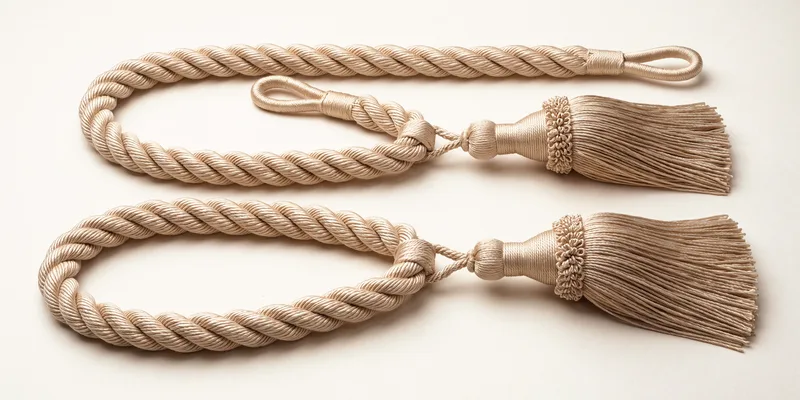
A tie back does two jobs: it lets light in and it shapes the fold of the curtain. Get the height and the cord weight right and the drape falls into a clean sweep every time you open it. Get them wrong and the fabric either sags, bunches, or pulls the pole. We make cord, tassels and trims for curtain workrooms in over 60 countries, so most of what follows is the practical side installers ask us about — where the hook goes, how long the loop needs to be, and which style suits which curtain.
We make rope and tassel tie backs in Jaipur, natural or dyed to your swatch; styles and the 5,000-piece minimum are on the curtain tie backs page.
What a tie back is meant to do
A tie back gathers the leading edge of a curtain and holds it clear of the glass. It is not just decoration — the position of the gather decides how much window you expose and how the folds read from across the room. A tie back set high and tight opens the whole pane and looks formal. Set low and loose, it leaves a soft belly of fabric and reads relaxed and casual. Both are correct; they are simply different looks, and the only variable you truly control is where the holding hook sits on the wall.
How high to hang tie backs
Start from the window, not the floor. Measure the full drop of the curtain from the top of the heading to the sill or floor, then place the tie back hook at one of two proven points:
| Placement | Where the hook sits | The look it gives |
|---|---|---|
| One-third up (high) | About one-third of the drop measured up from the sill | Open, formal, maximum light — best for tall or floor-length curtains |
| Halfway | At the vertical centre of the drop | Balanced and neutral — a safe default for most rooms |
| Two-thirds down (low) | About one-third of the drop measured down from the heading | Soft, casual drape with a fuller gather at the bottom |
A quick rule that avoids the "cut in half" look: never put the hook at the exact geometric middle of a full-length curtain if the window is short — it flattens the folds. For sill-length curtains, roughly two-thirds of the way down keeps the gather graceful. Horizontally, set the hook just outside the window frame so the gathered fabric clears the glass rather than covering it.
Match the cord to the curtain
The single most common mistake is a thin cord on a heavy curtain, or a thick rope on a light voile. The tie back has to physically restrain the fabric, so the weight of the cord should rise with the weight of the drape. Light sheers and linens sit well with a slim twisted cord; medium cottons want a fuller braided or twisted rope; heavy blackout and velvet curtains need a substantial rope or a wide fabric band that spreads the load and does not dig a line into the fabric. If you are ordering, tell us the curtain weight and drop and we can point you to the right diameter — that is exactly what our curtain tie backs range is built around.
Rope curtain tie backs
Rope is the workhorse. A twisted or braided rope tie back with a loop at each end drops over the wall hook and lasts for years because the load sits on the cord, not on stitching. Twisted rope gives a defined, rope-like spiral that suits traditional and coastal rooms. Braided rope is flatter and a little softer against delicate fabric. For both, get the length right: the loop needs to gather the curtain and reach back to the hook without strangling the folds. As a starting point, measure loosely around the gathered curtain at the chosen height and add a little slack — a tie back that is too short crushes the pleats, one that is too long lets the curtain slump.
Tassel tie backs
A tassel tie back is a rope or cord finished with one or two tassels that hang below the gather. It adds weight and a decorative drop, and it reads more formal or ornate than plain rope. Tassels suit longer curtains where the tail has room to hang cleanly; on a short sill curtain the tassel can pool awkwardly against the wall. Hang the cord as you would a rope tie back, and let the tassel fall naturally in front of the gather rather than tucking it behind. Because the tassel adds weight, a slightly stronger core cord keeps the shape over time.
Tie back ideas by room
- Formal living room: high placement, a full twisted rope or a double-tassel tie back for a tailored sweep.
- Bedroom: mid or low placement with a soft braided cord for an easy, restful drape.
- Kids' and casual rooms: a simple rope loop low down — quick to open, hard to damage.
- Kitchen and sill-length curtains: two-thirds-down placement, a slim cord, and no long tassel tail.
Fitting them cleanly
Use a proper tie back hook rated for the wall, fixed just outside the frame at your chosen height, and keep the two curtains symmetrical — measure both sides from the same reference point. Open and close the curtain a few times before you commit the fixing; the fabric will tell you if the height needs to move up or down an inch. For a whole-house or contract order where colour, cord weight and length all need to match across many windows, send us the specification and request a quote — our standard minimum is 1,000 m per SKU, and we can dye and finish rope, band and tassel styles to the same shade.
Frequently asked questions
How high should curtain tie backs be hung?
Measure the full drop of the curtain and place the hook either about one-third up from the sill for a high, open look, or two-thirds down for a softer drape. Avoid the exact middle on full-length curtains, as it flattens the folds. Fix the hook just outside the window frame so the gathered fabric clears the glass.
What length of tie back cord do I need?
Gather the curtain loosely at your chosen height, measure around it, and add a little slack. A tie back that is too short crushes the pleats and one that is too long lets the curtain slump. Cord weight should also rise with curtain weight — slim cord for sheers, heavier rope or a wide band for blackout and velvet.
Are rope or tassel tie backs better?
Rope tie backs are the durable, everyday choice because the load sits on the cord itself and they suit almost any curtain. Tassel tie backs add a decorative hanging drop and read more formal, but they work best on longer curtains where the tassel has room to fall. Both hang the same way over a wall hook.
Can you match tie backs across many windows?
Yes. For contract or whole-house orders we can dye and finish rope, band and tassel styles to a single matched shade and consistent cord weight. Our standard minimum is 1,000 m per SKU — send the colour, length and curtain weight through the quote page and we will confirm the right specification.