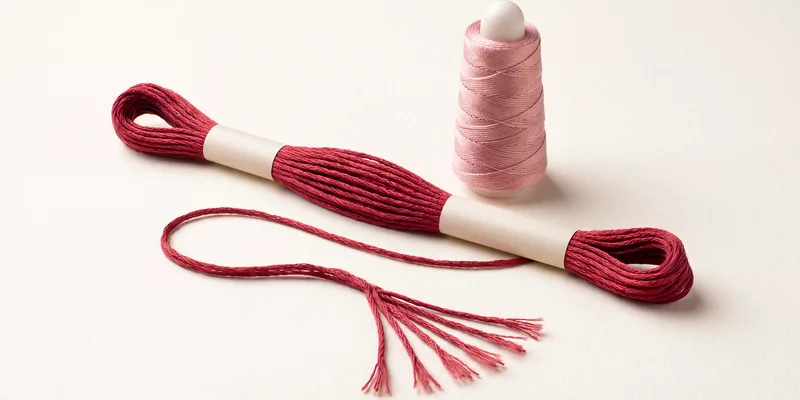
Walk into any embroidery floor and you will see cones that look almost identical from a distance. Up close, they behave very differently. The fibre they are spun from, the way they are twisted, and their thickness all decide how a design stitches out and how it survives washing and wear. As a Jaipur maker that has been producing and dyeing thread since 1991, here is how we sort the options for buyers who are choosing for the first time.
If you buy at volume, our embroidery thread page lists the cotton mouliné, cotton-look polyester and rayon machine thread we make in Jaipur, at 1,000 m per shade.
The main types of embroidery thread
Most decorative thread falls into a handful of fibre families. Each one has a job it does best.
- Rayon (viscose) embroidery thread — the classic high-sheen thread. Rayon and viscose are the same base material, so "viscose embroidery thread" and "rayon embroidery thread" refer to the same fibre. It has the brightest, softest lustre of the common types and runs smoothly at speed, which is why it is a favourite for logos, badges, and detailed fashion work. The trade-off is that it is less resistant to strong bleach and repeated industrial laundering than polyester.
- Polyester embroidery thread — the workhorse. Modern trilobal polyester is spun to reflect light almost as well as rayon, but it is stronger, colourfast, and stands up to chlorine bleach and hot washing. That makes it the sensible pick for uniforms, kidswear, sportswear, and anything that will be washed hard and often.
- Cotton embroidery thread — a matte, natural finish with a soft hand. Cotton is loved for hand embroidery, heirloom pieces, quilting, and any look where shine would feel wrong. It is gentle to stitch by hand but generally less abrasion-resistant at high machine speeds than polyester.
- Metallic thread — for accents and festive work. It delivers sparkle no other fibre can, but it is more delicate, so it is used for highlights rather than dense fills.
- Wool and acrylic — thicker, textured threads used for crewel work, tapestry, and bold surface texture rather than fine detail.
Rayon vs polyester embroidery thread
This is the decision most buyers actually agonise over, because these two cover the bulk of machine embroidery. The honest answer is that it depends on the end use, not on one being universally "better."
| Factor | Rayon / viscose | Polyester |
|---|---|---|
| Lustre | Very high, soft sheen | High with trilobal; slightly crisper |
| Strength | Good | Higher, more abrasion-resistant |
| Bleach resistance | Limited | Strong, handles chlorine |
| Colourfastness in hot wash | Good | Excellent |
| Best for | Fashion, badges, decorative detail | Uniforms, kidswear, sportswear, workwear |
A simple rule: if the piece is decorative or lightly laundered, rayon gives you a richer finish. If it will be washed at high temperature or bleached, polyester will keep its colour and hold up. Many factories keep both on the shelf and choose per order. You can see the ranges we produce on our embroidery thread page.
Understanding embroidery thread weight
Weight tells you how thick the thread is, and it changes both the look and the stitch count of a design. Embroidery weight is written as a number followed by "wt" — and it runs backwards from what you might expect. A higher number means a finer thread.
- 40wt — the standard for machine embroidery. If a design does not specify, it was almost certainly digitised for 40wt.
- 60wt — finer, for small lettering, fine detail, and delicate fabrics where 40wt would look heavy.
- 30wt — thicker, for bold coverage, a hand-stitched look, or when you want the thread to stand out with fewer passes.
- 12wt — heavy, mostly for hand embroidery and decorative topstitching.
Match the weight to the design and the fabric. Running a 30wt through a design digitised for 40wt will crowd the stitches; running 60wt where 40wt was intended can leave gaps. When in doubt, stay with 40wt and adjust density in the digitising instead.
How to choose, in practice
Instead of memorising specifications, ask three questions about the finished piece:
- How will it be washed? Hard, hot, or bleached laundering points to polyester. Gentle or decorative use opens the door to rayon or cotton.
- What finish do you want? Bright sheen leans rayon or trilobal polyester; a natural matte look leans cotton.
- How fine is the detail? Small lettering and delicate motifs want a finer 60wt; bold fills and a chunky look want 30wt; everything else is comfortable at 40wt.
For a production run, it is also worth thinking about consistency across dye lots and cone-to-cone tension, since those decide whether a large order stitches out uniformly. If you are matching a shade, sampling a fibre, or working out weights for a specific machine and fabric, tell us the end use and we will point you to the right build — you can request a quote and we will work from your actual requirement. Our standard minimum order is 1,000 m per SKU, which keeps colour and quality consistent across the batch.
There is no single best embroidery thread. There is the right thread for a given fabric, wash regime, and look — and once you frame the choice that way, the fibre and weight almost pick themselves.
Frequently asked questions
Is rayon or polyester embroidery thread better?
Neither is universally better; it depends on the end use. Rayon (viscose) gives a softer, brighter sheen and suits fashion and decorative work, while polyester is stronger, colourfast, and bleach-resistant, making it the right choice for uniforms, kidswear, and anything washed hard and often. Many workshops stock both and choose per order.
What does thread weight mean in embroidery?
Thread weight describes how thick the thread is, written as a number with 'wt'. The scale runs backwards, so a higher number is a finer thread: 40wt is the standard for machine embroidery, 60wt is finer for small lettering and detail, and 30wt is thicker for bold coverage. Match the weight to how the design was digitised.
Is viscose embroidery thread the same as rayon?
Yes. Viscose and rayon refer to the same regenerated-cellulose fibre, so 'viscose embroidery thread' and 'rayon embroidery thread' are two names for the same product. It is prized for its high lustre and smooth stitching, with the main limitation being lower resistance to strong bleach and heavy industrial laundering.
Which embroidery thread is best for items that are washed a lot?
Polyester embroidery thread is the safest choice for frequently washed items such as uniforms, sportswear, and kidswear because it resists chlorine bleach and holds its colour through hot washing. It is also more abrasion-resistant at high machine speeds, so the stitching stays crisp over the life of the garment.