The single most confusing thing about buying embroidery thread is that a bigger number means a thinner thread. Once that clicks, most of the guesswork around thread size, weight, and tension falls away. This guide walks through how the numbers work, when to choose one weight over another, and how to keep tension balanced so your stitches sit clean on both sides of the fabric.
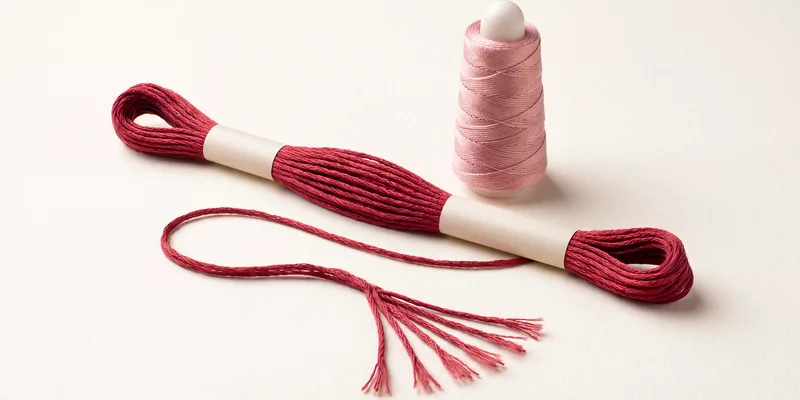
We twist, dye and wind embroidery thread in Jaipur — mouliné in skeins, machine thread on cones; fibres and put-ups are on the embroidery thread page.
What "weight" actually measures
Embroidery thread weight is a length-to-mass ratio, not a diameter. The common convention is: how many kilometres of that thread weigh one kilogram. If 40 km weigh a kilo, you have a 40 weight thread; if 60 km weigh a kilo, the thread is finer, so it is a 60 weight. That is why the numbers run backwards from intuition — a higher weight number packs more length into the same mass, which only happens if each strand is thinner.
You will also see thread described with a "Tex" or a "denier" figure, and sometimes a two-part number like 40/2, where the second digit is the number of plies twisted together. For everyday buying decisions, the weight number is the one that tells you how thick the finished stitch will look.
Embroidery thread size at a glance
| Weight | Relative thickness | Best for |
|---|---|---|
| 30wt | Bold, heavy | Redwork, quilting accents, coverage on loose knits |
| 40wt | Standard | Most logos, fills, and general machine embroidery |
| 50wt | Light-medium | Detail work, medium lettering, layered fills |
| 60wt | Fine | Small text, fine detail, tight-density designs |
Thickness is relative because different fibres and constructions behave differently even at the same nominal weight. A polyester 40wt and a rayon 40wt will not sit identically, but the weight number keeps you in the right neighbourhood.
40wt vs 60wt embroidery thread
Think of 40wt as your default and 60wt as your detail tool. A 40 weight is the workhorse of machine embroidery: it fills area quickly, gives strong colour coverage, and survives commercial wash cycles. Digitizers build most stock designs assuming 40wt, so if you are unsure, this is the safe choice.
A 60 weight is finer, so it shines where 40wt would look chunky — small lettering (roughly under 5 mm tall), fine outlines, dense small-scale detail, and photo-style stitching where strands need to blend. The trade-off is coverage: because each strand is thinner, you often need more stitches or a tighter density to fill the same area, and very fine thread is a little less forgiving on high-speed heads. A practical rule: choose the finest weight that still gives full coverage at the size you are stitching, and no finer.
Managing tension when you change weight
Tension is where good thread earns its keep, and it is the step most people skip. On a lockstitch embroidery machine, top thread and bobbin thread meet inside the fabric. Balanced tension means that meeting point sits hidden in the middle. When it is off, one thread pulls the other to its own side.
The classic check is the back of a column stitch: you want to see roughly one-third bobbin thread flanked by two-thirds top thread across the width — often called the "1/3 bobbin, 2/3 top" rule. If you see top-thread colour on the back, your top tension is too tight or bobbin too loose; if bobbin colour shows on the front, the reverse is true.
Every time you switch weight, re-balance:
- Going finer (40 to 60): reduce top tension slightly. Finer thread breaks more easily under the same pull.
- Going heavier (40 to 30): you may need to loosen top tension so the thicker strand feeds without snapping.
- Bobbin matters too: a consistent, correctly wound bobbin removes half of all tension complaints. Loose or uneven bobbin winds cause looping and thread breaks that look like a top-thread fault.
- Check thread path: nicks in the take-up, wrong needle size, or a dry thread that has lost its finish will all mimic a tension problem.
Match your needle to the thread as well. Finer thread wants a smaller needle eye and point (a 65/9 or 70/10 range for 60wt), while standard 40wt runs happily on a 75/11. An oversized needle on fine thread leaves visible holes; an undersized needle on heavy thread shreds the strand.
Choosing for the job
Start from the finished look and the fabric. Bold monograms on a tote or cap favour 40wt or even 30wt for presence. Fine lettering on a shirt pocket, medical or corporate name tags, and intricate crests favour 50–60wt. On stretchy or loosely woven fabric, a slightly heavier weight plus a stabiliser gives better coverage without gaps. When in doubt, stitch a small test swatch in the real thread on the real fabric before committing a full run — it costs a few minutes and saves a batch.
If you are sourcing thread for production and need consistent weight and colour across repeat orders, that consistency lot to lot is what separates a usable spool from a frustrating one. You can see our range on the embroidery thread page, and if you have a specific weight, shade, or volume in mind, you can request a quote and we will match it. Our standard minimum order is 1,000 m per SKU.
Quick reference
Higher number equals finer thread. Use 40wt as your default, drop to 60wt for fine detail and small text, and re-balance tension every time the weight changes — aiming for one-third bobbin showing on the back of a column stitch. Get those three habits right and the thread does what you designed it to do.
Frequently asked questions
Does a higher thread weight number mean a thicker thread?
No, it is the opposite. Weight is a length-to-mass ratio, so a higher number means more length fits in the same mass, which means each strand is thinner. A 60wt thread is finer than a 40wt thread.
What weight of embroidery thread should I use for most jobs?
40wt is the standard default for machine embroidery. It gives strong coverage, fills area quickly, and most digitized designs are built assuming it. Only move to a finer weight like 60wt when you need small lettering or fine detail.
How do I know if my thread tension is balanced?
Check the back of a satin or column stitch. You want to see roughly one-third bobbin thread in the centre with two-thirds top thread on either side. If top-thread colour shows on the back, the top tension is too tight; if bobbin colour shows on the front, it is too loose.
Why does my thread keep breaking when I switch to a finer weight?
Finer thread breaks more easily under the same pull, so reduce top tension slightly when going from 40wt to 60wt. Also fit a smaller needle so the eye and point suit the thinner strand, and confirm the bobbin is wound evenly.