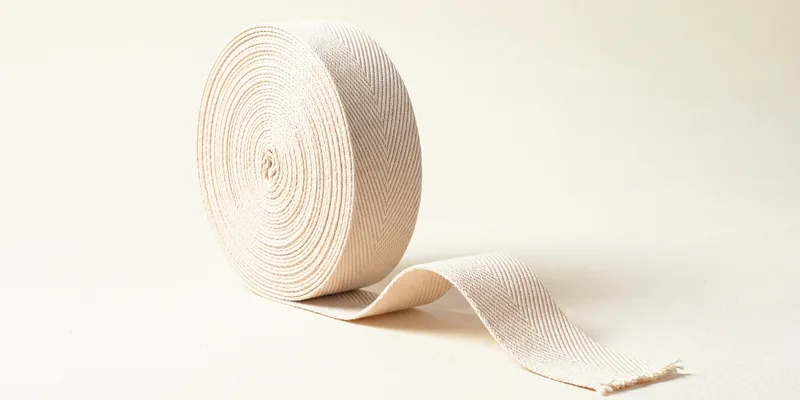
Cotton webbing is one of those materials people handle every day without naming it: the flat strap on a tote bag, the belt loop on a pair of trousers, the reinforced edge of an apron. On the factory floor we simply call it webbing. It is a flat, narrow, tightly woven cotton tape built to carry load along its length, and it has been a workhorse of bag, belt and apparel making for a long time.
We weave webbing in Jaipur from 10 mm to 100 mm wide, plain or striped; fibres, shades and the 1,000 m minimum are on the cotton webbing page.
This guide explains what cotton webbing actually is, how it is constructed, where it performs well, and how it compares with polyester so you can specify the right tape for your product.
What is cotton webbing?
Webbing is a woven textile made in strip form rather than as a wide fabric. Warp yarns run the length of the strap and carry the tension; weft yarns run across and bind the structure together. Because the weave is dense and the edges are woven closed (a selvedge edge, not a cut one), the strap does not fray and holds its width under pull.
Cotton webbing uses cotton yarn for that structure. That single choice drives everything buyers care about: it feels soft against the skin, it takes dye and print cleanly, it has a matte natural look rather than a plastic sheen, and it is easy to sew, fold and rivet. Two common constructions exist. Plain or basket weave is flat and economical; herringbone (twill) webbing has a visible diagonal rib, sits a little stiffer and reads as more premium. Widths typically run from about 10 mm up to 50 mm and beyond, with the thickness and yarn count set to match the load.
Cotton webbing uses
The material shows up wherever a strap must be strong enough to hold, but soft and good-looking enough to touch. Common applications include:
- Bag straps and handles: tote handles, shoulder straps, backpack detailing and inner reinforcement.
- Belts: casual fabric belts, uniform and cadet belts, and belt backing.
- Apparel and accessories: waistband tape, drawcords flattened into tape, dungaree and apron straps, lanyards.
- Home and craft: upholstery seat support, curtain and blind tape, pet collars and leads, macramé and decorative trim.
- Industrial edging: binding raw edges and reinforcing seams inside heavier goods.
If your product needs a strap that people will grip, wear or see up close, cotton webbing is usually a strong candidate. You can explore our stock constructions on the cotton webbing product page.
Webbing for bag straps
Bag straps are the most demanding everyday use, because the tape carries weight and gets handled constantly. A few things matter here. Width and thickness should match the bag: a light tote is comfortable on 25 mm tape, while a loaded shopper or luggage handle wants 38–50 mm to spread the load across the hand or shoulder. The weave density decides how much the strap stretches under load, so heavier bags call for a tighter, thicker construction. Where a strap meets the bag body, that junction takes the real stress, so it is usually box-stitched (the classic square-with-a-cross) to spread force across many stitches rather than one line.
Belt webbing
Belt webbing is a slightly different job. Here the tape is the visible product, so appearance and edge quality carry as much weight as strength. Herringbone constructions are popular for belts because the diagonal rib gives a textured, tailored look and resists rolling. For belts the tape also needs a stable width so buckles and keepers sit correctly, and a firm hand so the belt holds shape rather than flopping. Cotton takes dyeing well, which is why fabric belts come in such deep, even colours.
Cotton vs polyester webbing
This is the question we field most. Neither is simply better; they trade different strengths. Cotton wins on feel, natural look, breathability and how cleanly it sews and dyes. Polyester wins on tensile strength for its weight, moisture and rot resistance, and colour retention in sunlight. The honest guidance: choose by the job.
| Property | Cotton webbing | Polyester webbing |
|---|---|---|
| Hand feel | Soft, natural, matte | Firmer, slight sheen |
| Strength for weight | Good | Higher |
| Moisture and rot | Absorbs, can mildew if stored damp | Resists moisture |
| Dye and print | Excellent, deep colour | Good, needs disperse dye |
| Best for | Fashion bags, belts, apparel, skin contact | Outdoor, load slings, wet use |
In short: reach for cotton when the strap is seen, touched and worn, and for polyester when it lives outdoors, gets wet or must carry the heaviest sustained loads.
Specifying and ordering
When you brief a supplier, confirm four things: width, construction (plain or herringbone), colour, and the load the strap will carry. Those set the yarn count and thickness. Our standard minimum order is 1,000 m per SKU, which lets us dye a consistent lot and hold your colour across the run. If you are matching an existing strap or a Pantone reference, send a sample and we will build to it. When you know your specs, you can request a quote and we will confirm construction, colour and lead time.
Frequently asked questions
Is cotton webbing strong enough for heavy bag straps?
Yes, for most bags. Strength comes from width, thickness and weave density, so a tight 38-50 mm cotton tape carries a loaded shopper or luggage handle comfortably. For sustained industrial loads or wet, outdoor use, polyester is the safer choice.
What is the difference between plain and herringbone cotton webbing?
Plain (basket) weave is flat, smooth and economical. Herringbone has a visible diagonal rib, sits a little firmer and reads as more premium, which is why it is popular for belts and fashion bag straps.
Can cotton webbing be dyed to a specific colour?
Yes. Cotton takes dye cleanly and holds deep, even colour, which is one of its main advantages. Send a physical sample or a colour reference and we match it, dyeing a single lot so the shade stays consistent across your order.
What is the minimum order for cotton webbing?
Our standard minimum is 1,000 m per SKU. Ordering a full lot lets us keep colour and construction consistent across the run. Share your width, weave and colour on the quote page and we will confirm pricing and lead time.