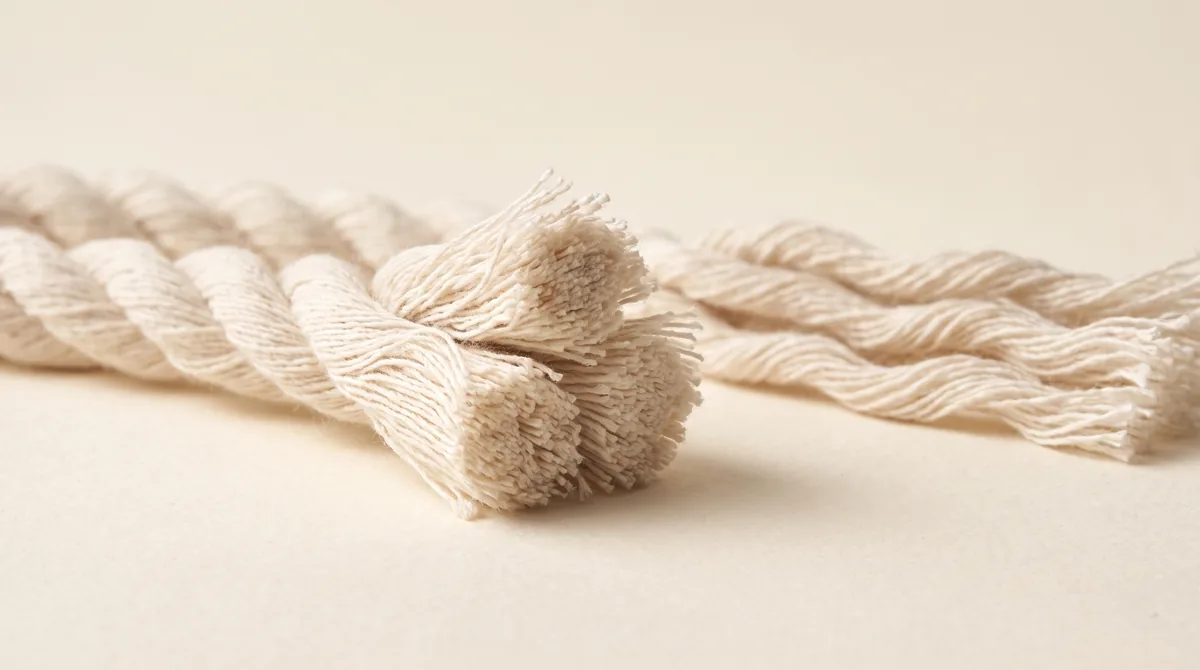
Most pricing disputes we are asked to sort out did not start at the factory. They started in the enquiry, with a line like "need 4mm cotton cord, best price". Two suppliers read that line, picture two different products, and quote two different numbers — and the buyer concludes the cheaper one is the better deal. We run twisting and braiding machines in Jaipur, and this post is the spec sheet we wish every first enquiry carried.
Why a diameter alone is not a spec
At the same 4 mm, a three-ply twisted cord and a sixteen-carrier braided cord are different articles. The twisted cord is denser, holds a knot with more bite, and untwists into fringe — which is why macrame buyers want it. The braid is lighter per metre, rounder in cross-section, and will not corkscrew — which is why drawstring buyers want it. Same fibre, same diameter, different machines, different gram weight, different price. A quote that does not say which one it covers is a guess.
The six lines that pin a cord down
1. Fibre. Cotton, recycled cotton, jute, polyester, nylon, or a blend — and if it matters to your market, say virgin or recycled explicitly. "Natural" is not a fibre.
2. Construction. Twisted or braided. If twisted, how many plies. If braided, how many carriers, and flat or round. This single line is the one most enquiries miss, and it moves price more than any other.
3. Finished diameter, measured flat. Measure with a caliper, without stretching or squashing the cord. Soft cords flatten by half a millimetre under a tight tape measure, which is how a supplier's honest 5 mm becomes a buyer's disappointed 4.5 mm at inspection.
4. Colour, against a standard. A physical cutting, a Pantone TCX number, or "undyed / greige" — one of the three, in writing. "Natural white" means four different shades in four mills; greige (unbleached, undyed) is not the same article as bleached white and does not cost the same.
5. Put-up. Hanks, coils, cones or spools; metres per unit; with or without core. Freight on cord is volumetric, so put-up moves the landed cost even when the ex-works price is identical. A container takes far more metres of tightly wound spools than of soft hanks.
6. Quantity per SKU, not per order. If you need five colours, the MOQ applies per colour at almost every mill, including ours. An enquiry that says "2,000 m across 5 shades" gets an accurate answer; "2,000 m" alone gets a surprise later.
A worked example
The difference in practice:
| Weak enquiry | Quotable enquiry |
|---|---|
| 4mm cotton cord, 5,000 m, best price | 4 mm, 3-ply twisted, spun polyester with a cotton-look matte finish, dyed to attached cutting, coreless 500 m coils, 5,000 m total across 2 shades, CIF Hamburg |
The second version takes two minutes longer to write. It is also the version where every factory that answers is pricing the same article, the sample you approve matches the bulk that arrives, and the inspection at your end has something objective to measure against.
What we do with an under-specified enquiry
We ask. Every time, before quoting — because a number given against a guess helps nobody. On our own range the fibre line is quick to settle: the natural, undyed cord is cotton, and every dyed shade is spun polyester finished matte and soft, so it looks and handles like cotton. At bulk volumes we can run other fibres to your specification. If you would rather skip that round-trip, put the six lines in the first message. Our product pages carry the construction and size range for everything we make, and the quote page asks for exactly these fields.
Frequently Asked Questions
How do I measure cord diameter correctly?
With a caliper, on a relaxed cord, without tension. Take three readings along a metre and average them. A tape measure pulled tight compresses soft cords and under-reads by up to half a millimetre.
What is the difference between twisted and braided cord?
Twisted cord is plies of yarn spiralled around each other — denser, better knot bite, can be untwisted into fringe. Braided cord is carriers interlaced over a core or hollow — rounder, more flexible, does not corkscrew. They price differently at the same diameter.
What does greige mean in a cord quote?
Greige is yarn or cord as it leaves the machine — unbleached, undyed, unwashed. It is the cheapest state, but it is not white: if your product needs white, specify bleached white, which is a processing step with a cost.
Why do suppliers quote different prices for the same cord?
Usually because the enquiry left room to quote different cords — a lighter construction, a recycled fibre, a hollow braid. Fix the six spec lines and most of the spread disappears; what remains is the real price difference between factories.
To convert an inch size to the nearest metric diameter, use the cord size chart.