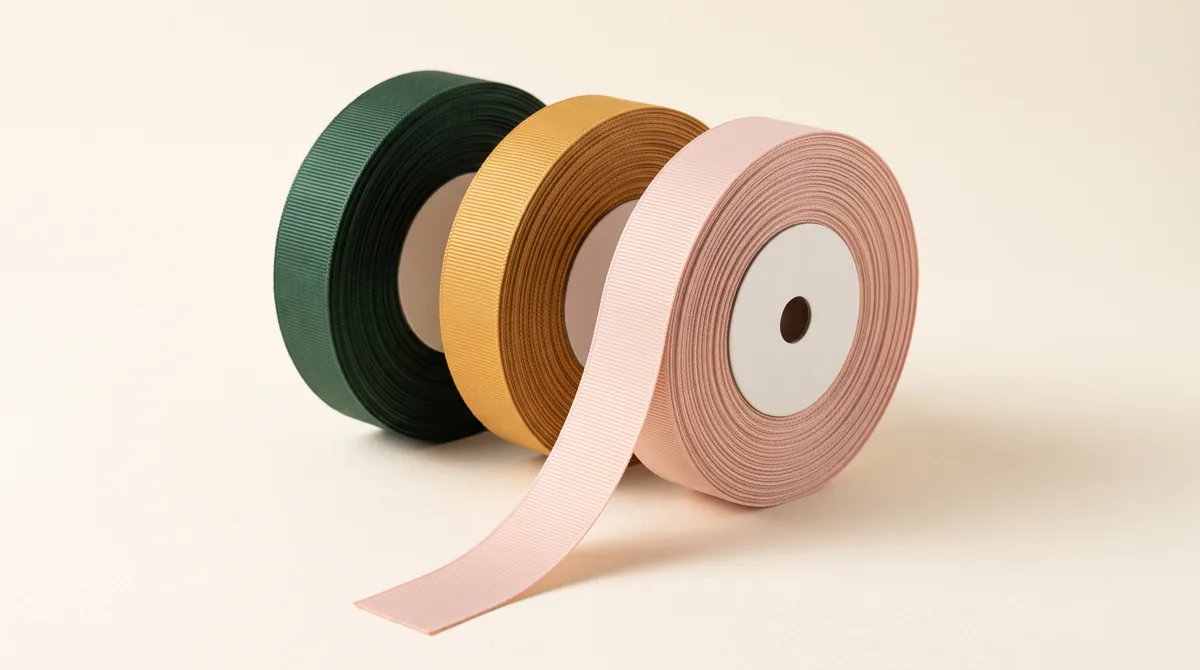
If you have ever held a school hair bow, a lanyard, or the waistband tape inside a pair of trousers, you have probably handled grosgrain ribbon without knowing its name. It is one of the most useful ribbons a workshop can keep on the shelf. Here is what it actually is, where it earns its place, and how to pick the right width, written from the floor of a ribbon and cordage factory rather than a catalogue.
We weave polyester grosgrain in widths from 3 mm to 100 mm, each shade dyed in-house to your reference — see the grosgrain ribbon page.
What is grosgrain ribbon?
Grosgrain (pronounced "grow-grain") is a firmly woven ribbon defined by the fine ribs that run across its width, from edge to edge. Those ribs are not printed or embossed. They are woven in: the warp yarns run the length of the ribbon and thicker weft yarns cross them, so the weft sits proud and creates the characteristic corded texture. The result is a ribbon with a matte, slightly rough surface and real body.
Most grosgrain today is woven from polyester, which gives good colour retention, strength, and value. It is also made in nylon, cotton, and blends where a specific hand-feel or fibre content is needed. The tightly packed weave gives grosgrain two practical traits that thinner ribbons lack: it resists fraying when cut, and it holds a crease or a loop instead of going limp.
What is grosgrain ribbon used for?
Because it is stiff, durable, and the same on both faces, grosgrain shows up across a wide range of work:
- Hair bows and accessories — one of the most common uses. Its stiffness lets a bow stand up and keep its shape all day.
- Apparel and tailoring — waistband stays, inside-neck taping, plackets, hat bands, and edge binding where a clean, matte trim is wanted.
- Lanyards, badge holders, and medals — the flat, hard-wearing surface takes printing well and survives daily handling.
- Gifts and packaging — bows and wraps that need to look crisp rather than glossy.
- Bag handles, drawstrings, and straps — light-duty webbing-style jobs where a ribbon is easier to sew than a cord.
- Millinery, dance, and costume — ties, sashes, and shoe straps that must hold tension.
- Craft, scrapbooking, and stationery — trims, bookmarks, and decoration.
For any of these, our grosgrain ribbon can be woven in the widths, colours, and fibre you need, plain or with edge and pattern options.
Grosgrain vs satin ribbon: how to choose
This is a question buyers ask often. The two ribbons behave very differently, and picking the wrong one is a common, avoidable mistake.
| Feature | Grosgrain | Satin |
|---|---|---|
| Surface | Matte, ribbed texture | Smooth, glossy sheen |
| Stiffness | Firm, holds its shape | Soft, drapes and flows |
| Both sides alike | Yes, reversible | Single-face satin has a dull back; double-face is glossy both sides |
| Durability | Hard-wearing, slow to fray | More delicate, catches and snags |
| Best for | Bows that stand up, trim, lanyards, straps | Flowing ties, elegant drape, soft decoration |
The short rule: reach for grosgrain when the ribbon has to work and keep its shape, and satin when you want shine and a soft fall. A hair bow that needs to stay perky wants grosgrain; a gift bow you want to cascade wants satin.
Grosgrain for hair bows
Hair bows deserve their own note because grosgrain suits them so well. The woven ribs give the loops enough backbone to stand out from the head instead of collapsing, and the matte surface photographs cleanly without glare — useful for anyone selling bows online. The tight weave also means the cut ends seal well with a light heat finish, so bows survive repeated wear and washing. For bow-making, the 22 mm and 38 mm widths are common workhorses, with narrower sizes used for layering and tails.
Common grosgrain ribbon widths
Grosgrain is woven in a standard ladder of widths. Metric and the nearest imperial sizes both get used, so it helps to see them side by side:
| Metric | Approx. imperial | Typical use |
|---|---|---|
| 3 mm | 1/8" | Fine detailing, doll and craft work |
| 6 mm | 1/4" | Narrow trim, thin ties |
| 10 mm | 3/8" | Card-making, small bows, edging |
| 16 mm | 5/8" | Apparel trim, medium bows |
| 22 mm | 7/8" | Standard hair bows, lanyards |
| 25 mm | 1" | Bows, straps, general use |
| 38 mm | 1 1/2" | Large statement bows, sashes |
| 50 mm+ | 2"+ | Hat bands, wide belting and decoration |
Widths can be woven to order rather than only stocked, so if your product needs an in-between size, that is a normal request. Colour, weight, and fibre are chosen the same way. If you are planning a run and want help matching width to end use, request a quote and tell us what the ribbon has to do — that is easier to spec correctly than a size alone.
A note on ordering
Grosgrain is woven in production lengths, not cut a metre at a time, so custom colours and widths are made to a minimum order — our standard is 1,000 m per SKU. Stock shades in common widths are usually the quickest route for smaller trials, while dedicated colours and sizes are best planned into a single order. Either way, tell us the fibre, width, colour, and the job, and we can point you to the practical option.
Frequently asked questions
Is grosgrain ribbon the same as petersham?
They look similar because both have crosswise ribs, but they are not identical. True petersham has a scalloped, flexible edge that lets it curve smoothly around a hat brim or curved seam, while standard grosgrain has straight, sealed edges and is used flat. For most trim, bow, and lanyard work, grosgrain is what you want.
Does grosgrain ribbon fray when you cut it?
Much less than lightweight ribbons, thanks to its tight weave. For a fully sealed end, cut polyester or nylon grosgrain with a hot knife or seal the tip briefly with heat. Cotton grosgrain frays more and is usually folded or stitched at the ends.
Which is better for hair bows, grosgrain or satin?
Grosgrain, in most cases. Its stiffness lets the loops stand up and hold their shape through a full day of wear, and the matte surface photographs without glare. Satin is softer and glossier, so it suits flowing decorative bows more than structured hair bows.
What fibres is grosgrain ribbon made from?
Most grosgrain is polyester for its strength, colour retention, and value. It is also woven in nylon, cotton, and blends where a particular feel or fibre content is required. The right choice depends on the end use, washing, and finish you need.