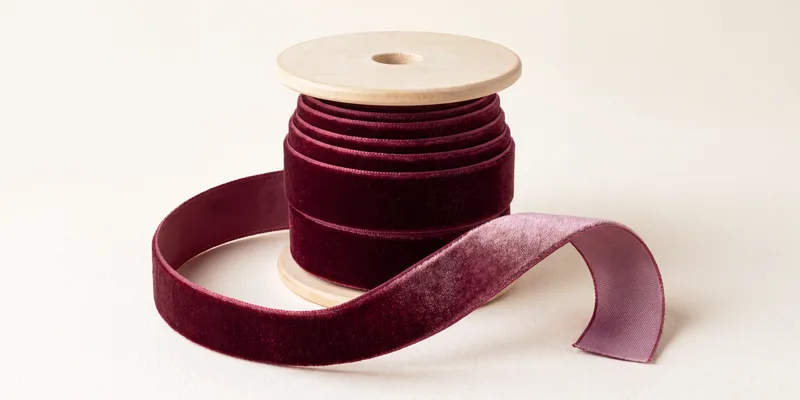
Velvet ribbon is one of those trims that people recognise instantly by touch before they can name it. It has a short, upright pile on the face that catches light and feels soft under the finger, backed by a flatter woven or knitted ground. That combination of a plush surface and a stable tape edge is what makes it so useful across both craft work and finished apparel. On the factory floor we make it the same way we make our other narrow fabrics: as a controlled, edge-finished tape, not as a strip cut from wide velvet cloth.
Ours is single-face velvet ribbon in six standard widths from 6 mm to 50 mm, dyed in our own dye house; standard shades are on the velvet ribbon page.
What velvet ribbon actually is
Structurally, velvet ribbon is a narrow textile with a raised pile. During weaving or knitting, extra yarn is worked into the surface and then formed into tiny loops that are cut to stand up as pile. That standing pile is the "nap" — brush it one way and it looks lighter, brush it the other way and it looks darker and richer. The base tape underneath holds the ribbon flat and gives it woven or heat-sealed selvedges so the edges do not fray in normal use.
Most velvet ribbon today is made from polyester or nylon pile, sometimes blended with cotton or rayon for a softer, more matte hand. Synthetic pile holds colour well, resists crushing, and stands up to repeated handling, which is why it dominates production ribbon. The important thing for a buyer to understand is that velvet ribbon is a defined tape product with a consistent width and a defined face — not a decorative offcut.
Single face vs double face velvet ribbon
The most common question we get is about face. It is simpler than it sounds.
- Single face velvet ribbon has pile on one side only. The reverse is a flat woven or satin-like back. It is the everyday choice: lower cost, and perfect anywhere only the front shows — flat trims, edging, appliqué, gift wrap, and most sewing where the ribbon lies against a surface.
- Double face velvet ribbon has pile on both sides. It costs more because it uses more pile yarn, but it is the right call whenever the back of the ribbon will be seen — bows, streamers, chokers, hanging loops, hat bands, and anything that twists or folds.
A quick rule from the workshop: if the ribbon will ever flip, loop, or dangle, spend on double face. If it stays flat against fabric, single face is the sensible, economical pick.
| Feature | Single face | Double face |
|---|---|---|
| Pile | One side | Both sides |
| Relative cost | Lower | Higher |
| Best for | Flat trims, edging, wrap | Bows, chokers, streamers |
| Back appearance | Flat woven | Velvet on both faces |
Common velvet ribbon widths
Width is where velvet ribbon earns its versatility. Narrow widths behave like a fine detail line; broad widths behave almost like a sash. As a working guide, the widths buyers reach for most often are:
- 3–6 mm: delicate jewellery, doll clothing, fine card-making, and thin edging.
- 9–10 mm: chokers, hair accessories, and slim garment trims.
- 16–25 mm: the workhorse range for bows, gift packaging, and apparel piping-style trims.
- 38 mm and up: hat bands, sashes, statement bows, and bold home-decor edging.
Because it is woven to width rather than cut, each roll keeps a clean, consistent edge along its whole length. If your project needs a width between the usual steps, that is a normal conversation to have when you request a quote — width, pile fibre, and colour are all specifiable.
Velvet ribbon for crafts
In craft use, velvet ribbon does the visual heavy lifting because the pile reads as "premium" even in small amounts. Common uses include gift wrapping and hampers, wreath and floral work, scrapbooking and card borders, hair bows and clips, jewellery such as chokers and wrap bracelets, ornament hangers, and trimming on cushions and lampshades. Its softness also makes it kind against skin, which is why wearable crafts lean on it so heavily. For gluing and stitching, single face is usually enough; for tied bows that show their back, choose double face so the knot looks finished from every angle.
Velvet ribbon in apparel
In garments and accessories, velvet ribbon moves from decoration to construction detail. Designers use it as neckline and cuff trim, waist and side-seam banding, drawstrings and ties, appliqué on dresses and jackets, and as the defining element on hats and fascinators. Because the pile adds subtle depth without added bulk, it lifts an otherwise plain seam. For apparel it is worth confirming the pile fibre and any wash expectations up front, since care behaviour depends on the fibre used. You can see our full construction and colour range on the velvet ribbon product page.
Working with velvet ribbon
A few practical habits keep velvet ribbon looking its best. Sew or brush with the nap, not against it, so the finish stays even. Seal cut ends with a light heat pass or a thin line of fabric glue to stop the pile shedding at the edge. Store rolls flat and out of strong pressure so the pile does not crush; if it does flatten, a brief pass of steam and a soft brush usually lifts it again. For production planning, remember our standard minimum order is 1,000 m per SKU, so it helps to settle on width, face, and colour before committing a run.
Frequently asked questions
Is velvet ribbon the same as velvet fabric cut into strips?
No. Quality velvet ribbon is woven or knitted to width as a narrow tape with finished selvedges, so its edges will not fray. Strips cut from wide velvet cloth have raw edges that shed and distort, which is why we produce ribbon as a dedicated tape rather than an offcut.
Should I choose single face or double face velvet ribbon?
Choose single face when only the front of the ribbon shows, such as flat trims, edging, and gift wrap, because it costs less. Choose double face whenever the back will be visible, like bows, chokers, and streamers, since it has pile on both sides for a finished look from every angle.
What velvet ribbon width should I use?
Match width to the job: 3 to 6 mm for fine detail and jewellery, 9 to 10 mm for chokers and slim trims, 16 to 25 mm for bows and packaging, and 38 mm and up for sashes and hat bands. If you need a width between the standard steps, ask about it when you request a quote.
How do I stop velvet ribbon ends from fraying?
Seal cut ends with a brief heat pass or a thin line of fabric glue so the pile does not shed. Also handle and sew with the nap rather than against it, and store rolls flat to keep the pile from crushing over time.