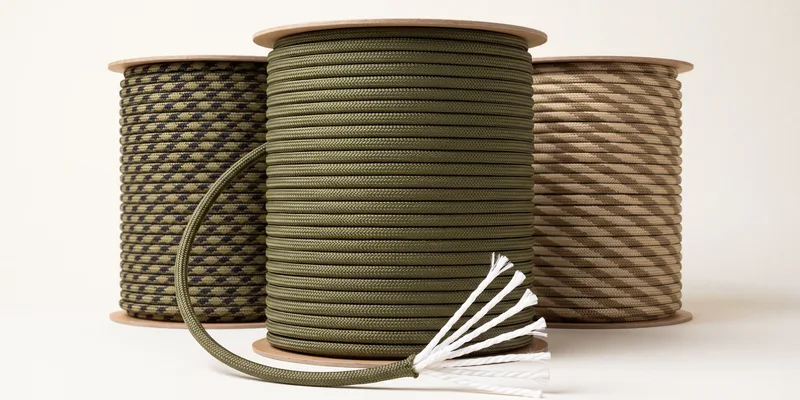
Paracord is one of those products people use constantly without ever stopping to ask what it actually is. On the factory floor we braid it every day, so here is the plain version: paracord is a lightweight, flexible rope built from a braided outer sheath wrapped around a bundle of separate inner strands. That construction is the whole point — it is what makes the cord strong for its weight, smooth to handle, and easy to repair in the field.
We braid 550-type paracord with a 7-strand core, plus 2 mm micro and 6 mm para-max, in polyester or nylon; details are on the paracord page.
What is paracord?
The name is short for "parachute cord." It started life as the suspension line on parachutes, where you need a rope that is thin, light, and does not snap under a sudden load. The design proved so practical that it spread far beyond parachutes into general utility use. Today "paracord" describes a family of braided cords in a range of thicknesses, colors, and strengths, used anywhere a small-diameter rope needs to punch above its weight.
What separates paracord from an ordinary rope is the two-part build: a tightly woven tube on the outside and loose load-bearing yarns running through the middle. Pull the two apart and you have two useful materials instead of one. That is why a single length of paracord can do so many different jobs.
What is paracord made of?
Genuine paracord is made from nylon. Nylon is chosen because it combines high tensile strength with stretch, abrasion resistance, and good resistance to rot and mildew — the qualities you want in a working cord that lives outdoors. Some budget or craft cords substitute polyester or polypropylene, which change how the cord behaves: polyester holds color and resists UV well but stretches less, while polypropylene is cheaper and floats but is weaker and more sensitive to sunlight.
The sheath and the inner strands are usually both nylon in a quality cord. The outer sheath is braided from many fine yarns, which is what gives paracord its characteristic smooth, slightly glossy surface and its flexibility. As a manufacturer we can braid paracord in solid colors, two-tone patterns, or camo-style mixes simply by arranging colored yarns in the braid, so color is a production choice, not an afterthought.
The inner strands — the part most people miss
Cut a piece of paracord and you will see several twisted yarns tucked inside the sheath. These inner strands, sometimes called the core, carry much of the cord's load. On the common "Type III" style cord there are typically seven to nine of these inner strands, and each one is itself made of two or three finer plies twisted together.
This matters in real use. You can pull the inner strands out and use them separately as fine thread for stitching, fishing line, snares, dental-floss-thin lashing, or gear repair, while keeping the empty sheath as a thin flat cord. It is this "rope inside a rope" idea that gives paracord its reputation as a survival and everyday-carry item. The strand count is a rough guide to grade — more inner strands generally means a heavier, stronger cord.
What does 550 paracord mean?
"550 paracord" is the version most people picture. The 550 refers to the minimum breaking strength in pounds — around 550 lb (roughly 250 kg) for a cord of that specification, with a diameter close to 4 mm and a seven-strand core. It is the general commercial reference point for a medium-duty paracord and the reason the number shows up on so many product listings.
It helps to separate two things. True military-specification cord is made to a defined government standard with tight requirements. Most cord sold as "550 paracord" is commercial cord built to a similar construction and strength target, which is perfectly good for everyday and outdoor use. As a factory we quote against the strength, diameter, material, and strand count a buyer actually needs, rather than a single label — so tell us the load and the use, and we will match the build.
| Common type | Approx. min. breaking strength | Inner strands | Typical use |
|---|---|---|---|
| Type I | ~95 lb | 1 | Light lacing, crafts |
| Type II | ~400 lb | 4–7 | General utility |
| Type III (550) | ~550 lb | 7–9 | All-round outdoor, EDC |
| Type IV | ~750 lb | 11 | Heavier loads |
What is paracord used for?
The short answer is: almost anything a light rope can do. Common uses include pitching tarps and tents, hanging gear, replacing broken bootlaces and drawstrings, lashing loads, making pull tabs and zipper pulls, dog leads and collars, and general repair work where you need something strong but packable.
Beyond utility, paracord has a huge craft and accessory life. It is woven into bracelets, keychains, lanyards, belts, bag handles, and macramé-style pieces, partly because it comes in so many colors and partly because the tight braid holds knots cleanly. The same properties that make it good in the field — abrasion resistance, a smooth surface, and a firm braid that holds knots cleanly — make it good for products people wear and carry. If you are sourcing for any of these, our paracord product page covers the diameters, colors, and grades we braid.
Buying paracord in bulk
If you are ordering for resale, crafting kits, or manufacturing, the things worth specifying are diameter, material (true nylon versus polyester or PP), inner strand count, breaking strength, and colors. Those five points decide both performance and price. Our standard minimum order is 1,000 m per SKU, and we can braid to a specific color or strength target. When you know roughly what you need, request a quote and we will confirm the build, lead time, and pricing.
Frequently asked questions
Is paracord the same as regular rope?
No. Paracord uses a braided outer sheath around separate inner strands, so it is far lighter and more packable than a solid twisted rope of similar strength. That two-part build also lets you pull the inner strands out to use as thread, which ordinary rope cannot do.
Is real paracord made of nylon or polyester?
Genuine paracord is made of nylon, chosen for its strength, stretch, and abrasion and rot resistance. Some cheaper or craft versions use polyester or polypropylene, which look similar but behave differently in strength, stretch, and UV resistance. If material matters for your use, specify nylon when ordering.
What does the 550 in 550 paracord mean?
The 550 is the approximate minimum breaking strength in pounds — about 550 lb, or roughly 250 kg. That grade is typically around 4 mm thick with a seven-strand core, which is why it is the most common all-round choice for outdoor and everyday use.
How many inner strands does paracord have?
It depends on the grade. Common Type III (550) cord usually has seven to nine inner strands, and each strand is itself made of two or three finer plies. More strands generally means a heavier, stronger cord, so strand count is a quick way to gauge grade.