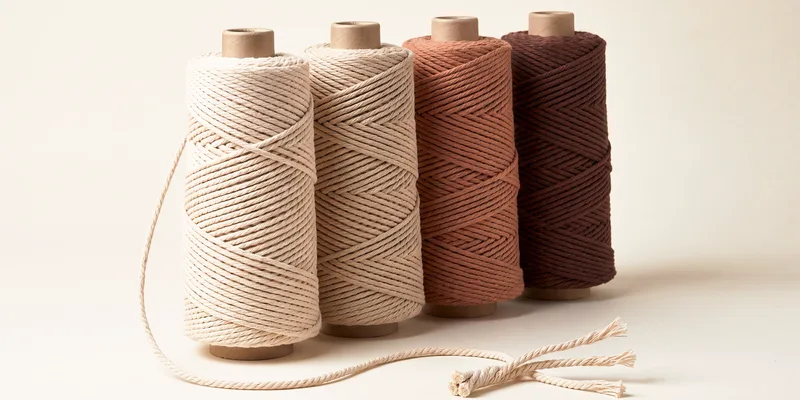
Every week an enquiry arrives for "3mm cord" that actually needs 5 mm, or a "thin rope" that turns out to mean 2 mm thread. Cord size sounds simple and costs real money when it is wrong — a macrame wall hanging knotted in the wrong diameter is a redo, and a carton of the wrong laces is a return. This is the reference we wish every buyer had before the first WhatsApp message.
Looking for the numbers only? The cord and rope size chart is the reference table: every diameter we list, in millimetres and exact inches, with the products made at each size.
How cord sizes actually work
Three things trip buyers up. First, millimetres measure the finished diameter, not the yarn inside — a soft-twist 4 mm and a hard-twist 4 mm carry different amounts of fibre. Second, ply count is not a size: "3-ply" tells you how many strands were twisted together, not how thick the result is; a 3-ply can be 1 mm or 10 mm. Third, inch equivalents are approximations — the trade rounds 3 mm to 1/8", 6 mm to 1/4", 10 mm to 3/8", and nobody mills cord to a thousandth of an inch.
On our floor a diameter claim is checked with a vernier caliper laid across the twist. If a supplier will not tell you how they measure, that is worth asking before you order a tonne of it.
The chart: what exists at every size
| Size band | Inches (approx.) | Trade words | What we make at this size |
|---|---|---|---|
| 0.5-1 mm | up to ~1/32" | dhaga, dori (fine) | Waxed cotton cord (0.5/0.8/1), elastic thread fine cores (0.5/0.7/1), rattail 1 mm, bakers twine, cotton yarn |
| 1-2 mm | ~1/16" | dori, patla dhaga | Bakers twine, rattail 2 mm, macrame cord from 1.5 mm, round elastic, waxed cotton 1.5/2 mm, jute twine from 2 mm, micro paracord |
| 2-3 mm | ~3/32-1/8" | dori, sutli (patli) | Danish cord (2-3, the chair-weaving range), paracord 2-3, rattail 3, crochet cord 3, garden twine from 3, round elastic 3, round laces from 2 |
| 3-6 mm | 1/8-1/4" | sutli, moti dori | Macrame cord (its most-ordered band), cotton rope from 3, 550-type paracord 4-6, bungee from 3, crochet cord 5, garden twine to 5, tufting yarn 2-6, cotton yarn to 5 |
| 6-10 mm | 1/4-3/8" | moti rassi, dori (heavy) | Macrame cord to 10, cotton rope, bungee cord to 12, placemat cords 4-10, flat laces 5-15 mm width, round laces to 8 |
| 10-32 mm | 3/8-1 1/4" | rassi, moti rassi | Cotton rope to ~30 mm, jute rope to 32 mm — the decorative, handle and railing band |
Every range above is the band we actually run, taken from the same spec tables published on each product page — not a generic industry chart. Diameters between listed sizes are made to order on most lines; the product page states each line's exact rule.
How buyers choose a size that survives the project
Match the diameter to the hardware first. A 10 mm rope through an 8 mm grommet is a production stoppage. Cleats, eyelets, cord locks and channel widths decide your ceiling before aesthetics do.
For knotting work, thickness sets the look and the labour. Fine diameters give dense, detailed knot patterns and slow work; heavy diameters give bold texture and fast coverage. That trade-off is why macrame studios keep two or three diameters in the same shade.
When in doubt, order a sample cut. A metre in the hand answers what no chart can — hand-feel, twist firmness, and whether the shade sits right against your material. We send cut samples of the sizes you shortlist before a bulk order.
Ordering by size, without the back-and-forth
The fastest enquiry we can quote names four things: diameter, construction (twisted or braided), fibre, and metreage. "4 mm braided cotton, natural, 5,000 m" gets a same-day number; "some medium rope" gets a conversation first. If you are matching an existing cord, post us a short cut of it — the caliper settles what words cannot.
Frequently asked questions
How do I convert cord mm to inches?
Multiply millimetres by 0.0394 — but in the cordage trade the working approximations are what matter: 3 mm ≈ 1/8 inch, 5 mm ≈ 3/16, 6 mm ≈ 1/4, 8 mm ≈ 5/16, 10 mm ≈ 3/8, 25 mm ≈ 1 inch. Suppliers mill to the metric size; the inch figure is a label, not a tolerance.
What is the difference between dori, sutli and rassi?
They are Hindi trade words for weight classes rather than precise sizes: dhaga and dori cover thread and fine cord (roughly under 3 mm), sutli is twine territory (about 2-5 mm, usually jute or cotton), and rassi means rope (roughly 6 mm upward). Buyers use them loosely, which is exactly why we confirm every enquiry in millimetres.
Is a 3-ply cord thicker than a 2-ply?
Not necessarily. Ply counts the strands twisted together, and each strand can be any weight — a fine 3-ply can be thinner than a heavy 2-ply. Compare finished diameter in millimetres, never ply count, when matching cords between suppliers.
What cord sizes do you actually manufacture?
From 0.5 mm waxed cotton and elastic-thread cores up to 32 mm jute rope, across twisted and braided constructions — the chart above lists each band with the exact products. Diameters between standard sizes are made to order on most lines, and every product page states its own range.