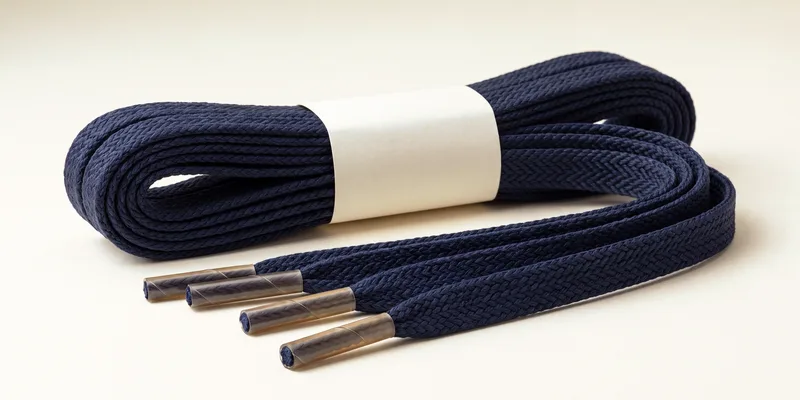
A footwear line's lace decision looks cosmetic until returns start mentioning "keeps coming untied" or eyelets start chewing laces. Flat versus round is a real engineering choice, and since both constructions run on our braiding machines, here it is without a side.
We braid flat laces 5 to 15 mm wide, round laces 2 to 8 mm across, and oval; lengths, aglets and the 5,000-pair minimum are on the shoelaces page.
The two constructions
Flat laces are braided as a ribbon — ours run 5-15 mm wide. The flat profile puts more lace surface in contact with itself inside a bow, which is why a flat lace holds a knot noticeably better through a day of walking.
Round laces are braided as a tube or around a core — ours run 2-8 mm diameter. The round section slides through eyelets with less friction, seats into narrow eyelets that would crease a flat lace, and gives the tailored line dress shoes want.
Side by side
| Property | Flat | Round |
|---|---|---|
| Knot hold | Better — more surface contact in the bow | Looser, especially in slick braids |
| Look | Casual, sporty, wide visual presence | Clean, tailored, minimal |
| Eyelet behaviour | Can bunch in small eyelets | Feeds smoothly, suits narrow eyelets |
| Natural home | Sneakers, canvas shoes, skate and school shoes | Dress shoes, formal boots, hiking boots (heavier diameters) |
| Our range | 5-15 mm widths | 2-8 mm diameters |
What footwear buyers actually specify
Length by eyelet count. More eyelet pairs need longer laces — a low-cut sneaker and a tall boot can differ by half a metre. We cut to order across 45-200 cm, so the specification is your shoe model's measured lace, not a nearest-fit compromise.
Tipping. The aglet decides how the lace ages. Ours are tipped in-house — acetate as standard, metal aglets where the line wants the premium cue — and the tipping machine sits on the same floor as the braiders, which is why OEM runs ship as one finished piece rather than an assembly of vendors.
Fibre and finish. The same flat-or-round choice repeats in fibre: natural cotton for the heritage look, dyed shades in spun polyester for colour that survives the laundry. The full logic is in our cotton vs polyester guide.
Stocking logic for retail ranges
Ranges rarely pick one: the working split we see is flat laces across the sneaker wall and round in two diameters (a fine dress gauge and a heavy boot gauge). Because every width-length-shade combination is its own SKU at 5,000 pairs, planning the split before the enquiry keeps the quote clean — our shoelace page carries the full spec table.
Frequently asked questions
Why do round shoelaces come untied more than flat ones?
A bow holds by friction, and a flat lace presses more surface against itself inside the knot than a round section does. Slick round braids amplify it. Textured braids and waxed finishes claw some hold back, but if untying complaints are the concern, flat construction is the structural fix.
What length shoelace do I need for my shoes?
It scales with eyelet pairs — low sneakers need far shorter laces than tall boots, and the honest method is measuring the lace your shoe model actually carries. We cut to order anywhere in 45-200 cm, so an OEM run matches your last's real requirement instead of a catalogue's nearest size.
What is the difference between acetate and metal aglets?
Acetate (the standard clear tip) is light, economical and what most sneakers wear; metal aglets add weight, durability and a visible premium cue for boot and fashion lines. Both are tipped on our own machine in Jaipur, and both are specified per SKU in the same quote.
What is the minimum order for custom shoelaces?
5,000 pairs per SKU, where each width-length-shade combination counts as its own SKU. Cut lengths run 45-200 cm to order, flat 5-15 mm and round 2-8 mm, with in-house dyeing and tipping — and the quote for a full range split comes back within one working day.
Once you have picked a shape, the shoelace length chart helps you pick the length.