Walk into our braiding hall in Jaipur and every machine is making a different lace: 8 mm flat polyester for sneakers on one row, 3 mm waxed rounds for dress shoes on the next, heavy 5 mm cored boot laces behind it. "Shoelace" is not one product — it is a family, and choosing the wrong member is why laces slip, fray or look wrong on the shoe. This guide maps the whole family the way we spec it at the factory: by shape, by material, by construction, and by the job the lace has to do.
Of that family, we braid flat, round and oval laces and tip them in-house in Jaipur; lengths, aglets and minimums are on the shoelace product page.
Flat, Round and Oval Shoelaces — the Three Shapes
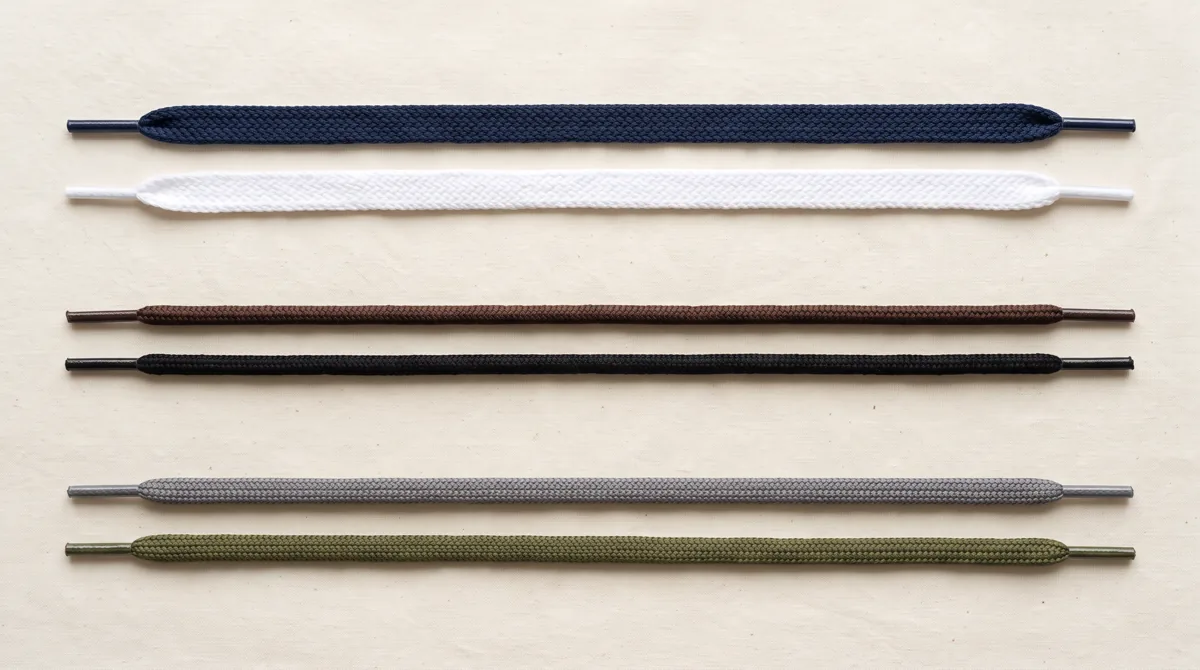
Flat laces are the sneaker standard, usually 5-15 mm wide. A flat braid gives a knot the most contact surface, so flat laces hold bows better than any other shape — and their wide face carries colour well, which is why fashion and skate shoes use them almost exclusively. Most are braided as a hollow tube that presses flat.
Round laces are braided over a core that keeps them cylindrical, typically 2-6 mm across. They slide through eyelets with less friction — better for shoes with many eyelets or speed hooks — but the same low friction means round laces untie more easily unless they are waxed or tied with a heel lock. Thin waxed rounds are the dress-shoe standard; thick rounds run boots.
Oval (semi-round) laces split the difference: a slightly flattened tube, usually 4-6 mm, that grips like a flat but threads like a round. Athletic brands ship them on running shoes for exactly that reason.
Shoelace Materials: Polyester, Waxed Cotton, Leather and Elastic
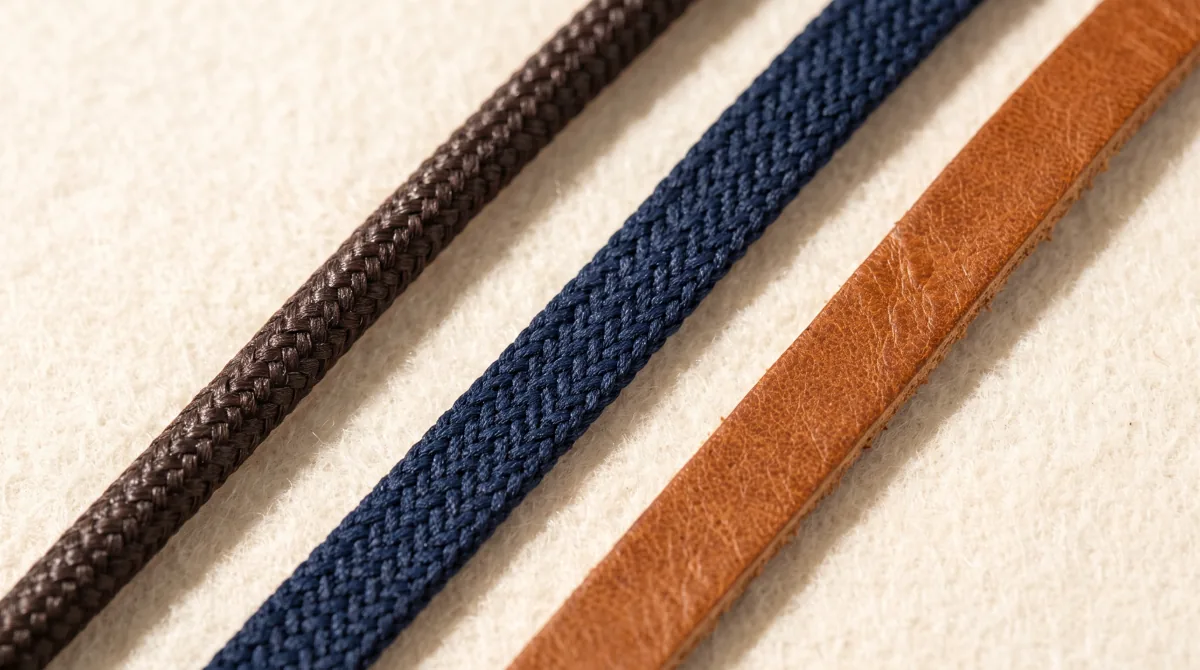
Polyester is the workhorse — strong, colourfast, cheap to dye to any shade, and it shrugs off water and UV. Nearly every sneaker lace made today is braided polyester. Nylon is slightly stronger and stretchier but slicker, so knots need more care; it suits sport and outdoor laces. Spun cotton gives the matte, vintage look heritage sneaker brands want, grips knots beautifully, but wears faster and fades sooner than synthetic fibre.
Waxed cotton is cotton braided and then run through a wax bath. The wax adds water resistance, a slight sheen, and — most importantly — grip: a waxed lace holds a small bow all day, which is why it owns the dress-shoe category and premium boots. Leather laces are cut strips rather than braids, used on boat shoes and moccasins; they look right on those shoes but hold knots poorly and stretch with wear. Elastic shoelaces — braided over rubber strands or fully knitted stretch cord, sometimes sold as rubber shoelaces — turn any shoe into a slip-on. This is the no-tie shoelaces category — we cover how they work and how to fit them in a dedicated guide — for kids, seniors, triathletes and anyone tired of bows.
On our own lace range the fibre line is simple: the natural, undyed lace is cotton, and every dyed shade is spun polyester finished matte so it reads and handles like cotton rather than like plastic. At bulk volumes we can run other fibres to a buyer's specification.
Shoelace Size Guide: Which Type and Length for Which Shoe
| Shoe | Lace type | Typical spec |
|---|---|---|
| Casual sneaker | Flat braided polyester | 8-10 mm wide, 90-120 cm |
| Skate shoe | Wide flat polyester | 10-15 mm, thick braid, 114-137 cm |
| Running shoe | Oval or flat, slight stretch | 5-6 mm, 100-120 cm |
| Dress oxford | Thin waxed cotton round | 2-3 mm, 60-80 cm |
| Work / hiking boot | Heavy round or oval, cored | 4-6 mm, 140-200 cm |
| Boat shoe / moccasin | Leather strip | ~3 mm square cut, 90-120 cm |
| Kids / no-tie | Elastic braid or knit | 5-7 mm, cut-to-fit or lock toggle |
For a fuller shoelace length chart by eyelet count — including the boot lace length chart — see our guide to tying shoelaces, which pairs each length with the knot that suits it.
Boot laces deserve one extra note: they live a harder life than any other lace — abrasion from speed hooks, mud, freeze-thaw — so the braid is tighter, the core is often a blended yarn for strength, and many work-boot buyers now spec aramid-blend cores that will not melt against a hot surface. If your boot laces keep snapping at the hooks, the fix is a tighter braid and a cored construction, not just "a thicker lace".
Colour ranges and dye lots
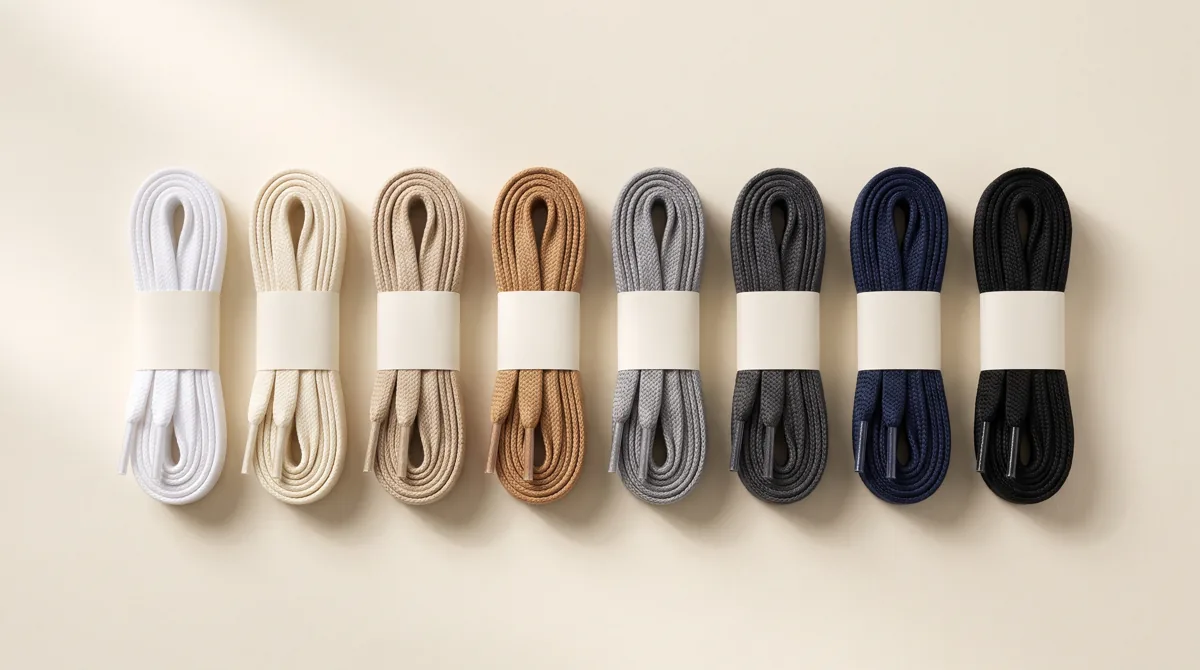
Retail lace programs live and die on shade consistency — a replacement-lace wall needs this season's white to match last season's. That is a dye-house problem more than a braiding problem: we dye polyester in-house and hold the recipe per shade, so a reorder lands on the same tone.
Aglets: the small part that decides lace life
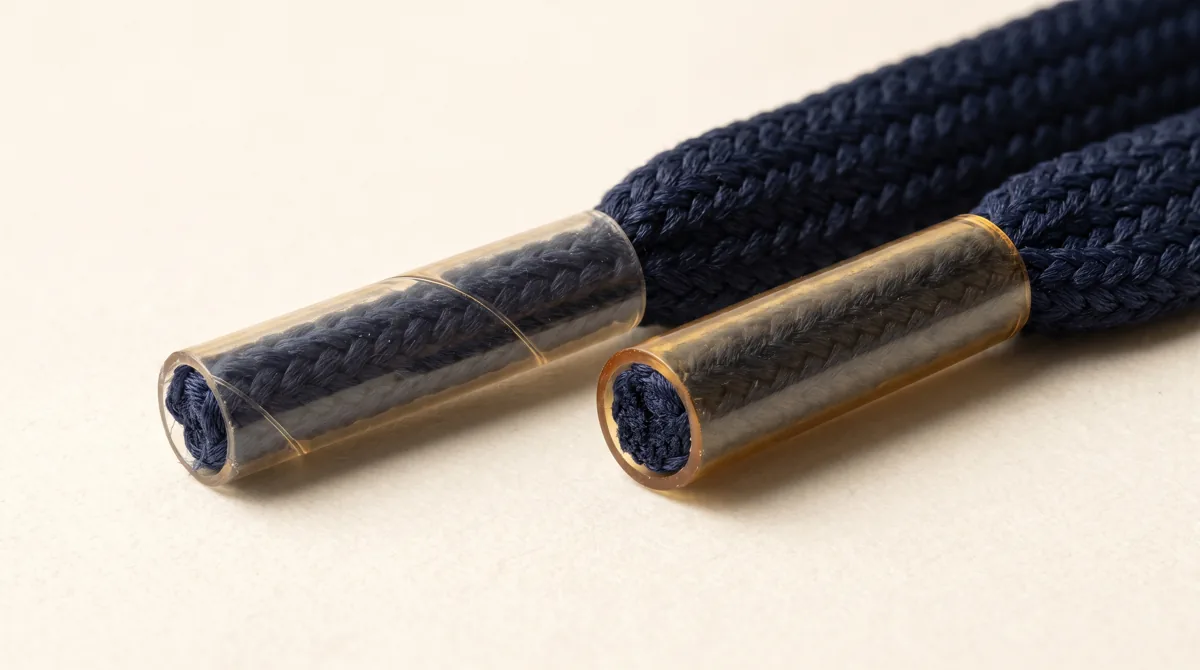
The tip — the aglet — is where most laces die. The standard is a cellulose acetate film wrapped and heat-shrunk around the braid: light, flexible, and it threads through eyelets without fraying. Metal aglets look premium on fashion laces but can chew eyelet finishes; moulded plastic tips are the budget route and crack first. When an aglet fails, the braid unravels within weeks — so on a wholesale spec sheet, tip material and tip length (12-18 mm typical) matter as much as the lace itself.
How to choose, in three questions
- What must the knot do? Stay tied all day with zero fuss → flat, or waxed round. Slide fast through many eyelets → round or oval. No knot at all → elastic.
- What does the shoe demand visually? Dress shoes want thin dark rounds; heritage sneakers want spun cotton flats; skate shoes want fat bright flats.
- What will the lace endure? Weather and abrasion → polyester or cored boot lace; wet decks → leather look but polyester practicality; small hands → elastic.
If you buy laces commercially — for a footwear line, a repair chain, or replacement-pack retail — the same three questions become your spec sheet lines, plus width, length, colour standard and tip. Our wholesale shoelaces page lists what we braid and tip to order, our guide on tying laces so they stay tied covers the knots, and a quote takes one working day.
Frequently Asked Questions
What are the main types of shoelaces?
By shape: flat, round and oval. By material: polyester, nylon, cotton, waxed cotton, leather and elastic. By construction: hollow braids that press flat, and cored braids that stay round. Most laces on the market are one of three combinations — flat braided polyester (sneakers), thin waxed cotton rounds (dress shoes) or heavy cored rounds (boots).
Which type of shoelace stays tied best?
Flat laces hold knots best because the knot gets more contact surface, and waxed cotton grips hardest of any finish. The most secure everyday combination is a flat or waxed lace tied in a square bow. Slick round nylon laces untie most easily.
What are shoelaces made of?
Mostly braided polyester today, with nylon for sport laces, spun or waxed cotton for heritage and dress styles, leather strips for boat shoes, and elastic blends for no-tie laces. The tip is usually cellulose acetate film heat-shrunk onto the braid.
What length shoelaces do I need?
It depends on eyelet pairs: roughly 60-80 cm for a dress shoe (3-5 pairs), 90-120 cm for sneakers (5-6 pairs), 120-140 cm for running shoes and high-tops (7 pairs), and 140-200 cm for boots (8+ pairs). Flat laces need a little more length than round for the same shoe.
What are no tie shoelaces?
No-tie shoelaces are elastic laces — braided over rubber strands or knitted from stretch yarn — that you fit once and never tie again; the shoe goes on and off like a slip-on. They come as cut-to-fit laces with lock toggles or as pre-sized loops, and they are the standard answer for kids' shoes, seniors and triathlon transitions.
Are elastic no-tie laces any good?
For the right user, yes. They turn laced shoes into slip-ons, which is exactly what kids, seniors and triathletes need, and modern knitted versions hold the foot well for everyday wear. For running long distances or heavy boots, a conventional lace with a heel lock still gives more precise tension control.