Every lace we braid at our factory in Jaipur exists to be tied — except one family. Elastic no-tie laces are the fastest-growing corner of the lace trade, and the reason is simple: they delete the knot entirely. Fit them once, adjust the tension, and the shoe becomes a slip-on that still looks laced. Here is how they actually work, who genuinely benefits, and where a conventional lace still wins.
How no tie shoelaces work
The lace itself is the mechanism. A no-tie lace is braided over strands of rubber or spandex — or knitted entirely from stretch yarn — so the lace elongates when the foot pushes in and pulls the shoe snug again the moment the foot is seated. Tension that a knot normally provides comes from the elastic instead, spread evenly across every eyelet rather than concentrated at a bow. That even spread is why many wearers find them more comfortable than tied laces: no pressure ridge across the instep.
The two types: lock toggles and pre-sized loops
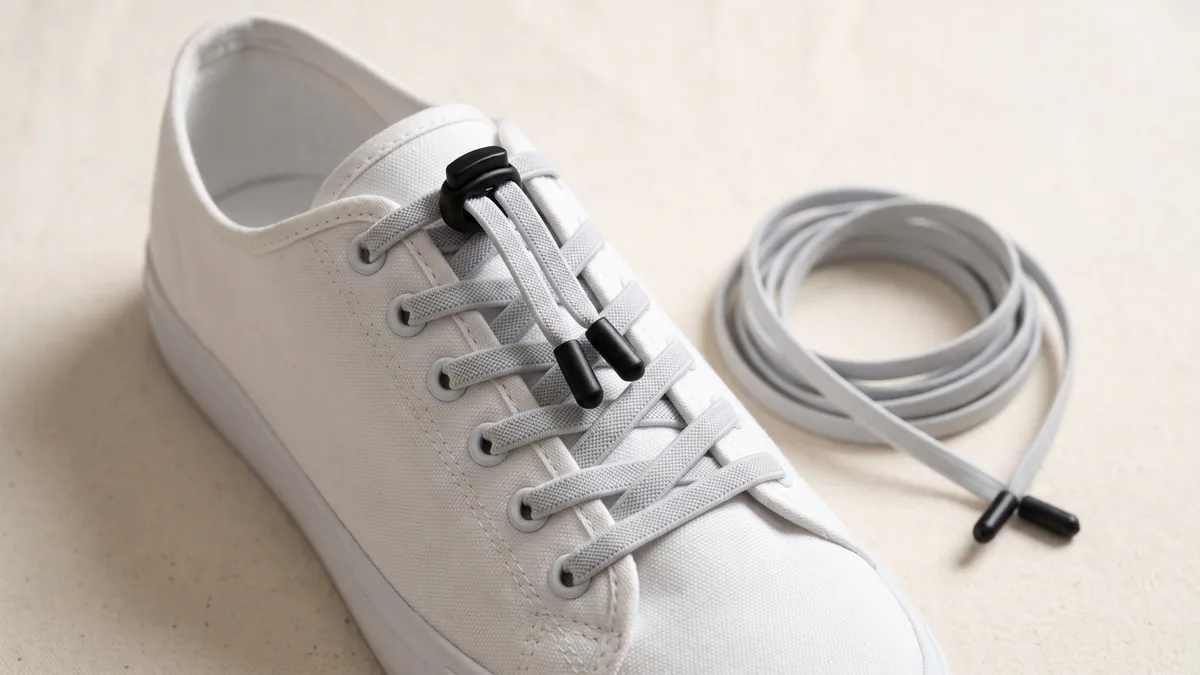
Cut-to-fit with a lock toggle. A continuous elastic cord — usually 3-5 mm round or a 5-7 mm flat — laces through the eyelets like a normal lace, then a small spring-loaded toggle clamps both ends at your chosen tension. You cut off the excess and cap the ends. One size fits every shoe, tension is adjustable any time, and this is the style triathletes use because it is the fastest possible transition.
Pre-sized loops and bands. Individual knitted or silicone segments stretch between eyelet pairs, or a pre-tied elastic lace comes with the bow already formed and sewn. Nothing to cut, the cleanest look — the visible "bow" never moves — but sizing must match the shoe, and tension is fixed per segment rather than adjustable overall.
Who no-tie laces are really for
Kids get the obvious win — shoes go on in seconds and never come undone on a playground. Seniors and anyone with limited dexterity or back pain get independence: no bending, no fine finger work, which is why occupational therapists recommend elastic laces after strokes, surgery or with arthritis. Triathletes and obstacle racers save 10-20 seconds per transition. Runners in training use them for even instep pressure, though many switch back to conventional laces with a heel lock for race distances where precise tension matters. And anyone who treats sneakers as slip-ons anyway — the largest group of all — stops crushing the heel counters of their shoes.
Fitting them right (this is where most people go wrong)
- Lace at half tension. Thread the elastic with the shoe ON your foot, not empty — an empty shoe fitted tight becomes a clamp once a foot is inside.
- Set the toggle with the foot seated. Snug at the instep, looser over the toes. You should slide the shoe off without touching the toggle.
- Cut with 2-3 cm spare and fit the end caps; bare-cut elastic frays and the rubber strands retreat into the braid.
- Re-check after a week. New elastic settles slightly; one toggle click usually restores the original feel.
Honest trade-offs
Elastic gives, and that is both the feature and the limit. For court sports with hard lateral cuts, for hiking with a loaded pack, and for work boots, a conventional lace holds the foot more precisely — stretch at the wrong moment is slop you do not want. Elastic also ages faster than polyester: UV, sweat and repeated stretch cycles cost a no-tie lace its snap in roughly a year of daily wear, while a braided polyester lace outlives the shoe. The practical pattern we see from repeat buyers: no-tie on everyday and kids' shoes, conventional on performance and work footwear.
What to look for in the elastic itself
This is the part we know from the production side. Good no-tie laces are braided with the rubber or spandex fully covered — if you can see bare rubber between the braid yarns at rest, the cover was braided too loose and the lace will pill and snap early. Recovery matters more than stretch: a quality elastic lace stretches to roughly double its length and returns fully, time after time; a cheap one bags out within weeks and the "snug" disappears. Flat profiles spread pressure better on thin sneaker tongues; round cords thread faster through small eyelets. We braid both — the same construction logic as our round elastic cord and covered elastics, tipped or toggle-ready to order alongside our standard lace program — and if you are building a no-tie SKU for retail or a shoe line, we quote within one working day.
Frequently Asked Questions
Do no tie shoelaces actually work?
Yes, for their intended use: everyday shoes, kids, accessibility needs and fast transitions. The elastic holds the shoe snug while letting the foot slide in and out. Where they compromise is precision — for hard lateral sports, heavy packs or work boots, a tied lace still controls the foot better.
How do you put on no tie shoelaces?
Thread the elastic lace through the eyelets like a normal lace, put the shoe on, set the toggle tension with your foot seated — snug at the instep, easier over the toes — then trim the excess to 2-3 cm and fit the end caps. Re-check the tension after the first week as the elastic settles.
How long do elastic no-tie laces last?
Roughly a year of daily wear before the stretch noticeably softens — UV, sweat and stretch cycles age the rubber core faster than the polyester cover. Quality matters: fully covered braids with good recovery last several times longer than bargain versions that bag out in weeks.
Are no tie shoelaces good for running?
For training and even instep pressure, many runners like them. For race distances and technical trails, most switch back to conventional laces with a runner's heel lock, because a tied lace lets you set different tension zones and does not stretch mid-stride.