Every September my inbox fills with the same message: "Can you ship 500 meters of 3mm cord before Black Friday?" And every September I have to tell half of them no — not because we can't make it, but because they've left no time for freight. I run a cord factory in Jaipur, Rajasthan. We've been twisting and braiding since 1991, and we ship to 60+ countries. This is the guide I wish every first-time wholesale buyer would read before emailing me.
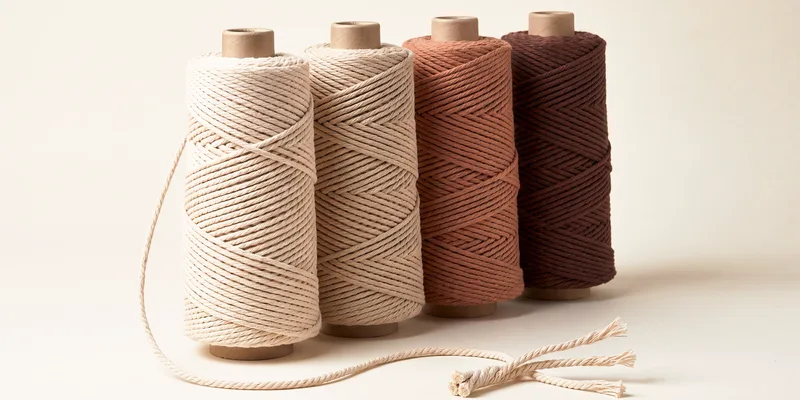
First, the basics. Macrame cord is a twisted or braided cord, usually 2mm to 10mm thick, used for knotting wall hangings, plant hangers, bags, and jewellery. On our floor it comes two ways, and you should pick one before you talk price. The natural, undyed cord is cotton — it needs no dyeing, so cotton is what we run. Every dyed colour is spun polyester, finished to look and feel like cotton: matte, soft, no synthetic shine. We run polyester on the coloured range because it takes colour fast and repeats shade to shade, order after order. Simple product. Surprisingly easy to buy wrong.
And timing matters more than price. Demand peaks with the Sep-Dec craft season. If your stock lands in December, you've missed it.
How Do MOQs Work When You Buy Macrame Cord Wholesale?
MOQ means minimum order quantity, and in India it's usually set per SKU — per colour, per thickness — not per total order. Ours is 1,000 meters per SKU. So instead of committing to 1,000 meters of one beige, you can order ten colours at 1,000 meters each and find out what your customers actually buy.
One trap: some factories quote per kg, others per meter. Ask which. A 3mm single-twist and a 3mm braided cord weigh very differently per meter, and that changes your landed cost completely.
Air or Sea Freight — Which Should Your First Order Use?
Air courier takes 7-14 days door to door. Sea takes 25-40 days depending on your port and customs. Air costs more per kg but has no minimum volume; sea only makes sense once you're moving real weight.
| Air courier | Sea freight | |
|---|---|---|
| Transit time | 7-14 days | 25-40 days |
| Best for | First orders, samples, urgent restocks | Bulk seasonal stock |
| Cost per kg | Higher | Much lower at volume |
| Main risk | Low — tracked door to door | Port delays, customs holds |
My rule: first order goes by air, always. Learn the product, learn the supplier, then switch to sea for season stock.
What Specs Should You Ask For Before Paying?
Photos lie. Specs don't. Before you pay anyone — including us — get these five things in writing (our guide on how to specify a cord covers the full spec sheet):
- Fibre — natural cotton or dyed cotton-look polyester. With us the rule is simple: undyed is cotton, anything dyed is spun polyester. Decide this per colour before anything else, because it drives price, hand feel, and how the shade behaves over time.
- Diameter in mm — and ask how they measure it. One factory's 3mm is another's 2.6mm.
- Twist or braid — single strand, 3-ply twisted, or braided, plus how tight you want the twist. A loose twist brushes out beautifully for fringe; a tight one holds its shape; a braid stays round and frays far less. It changes how the cord takes a knot, so say it in the order.
- Shade standard — send a physical reference, or agree one from our shade card, and state whether you need it to repeat on your next order. The dyed polyester range is where shade repeatability and colour fastness live; ask us directly whether the burgundy will bleed onto a white wall hanging and you'll get a straight answer, because we dye in-house. Natural cotton is undyed, so judge it on the greige tone in front of you, not on a screen.
- Put-up — how it's wound and how much per unit: roll, cone or skein, and meters on each. Our rolls ship plain, with no band or label on them, so get the count and the put-up written into the PO rather than assuming.
What Mistakes Do First-Time Buyers Keep Making?
Over three decades of orders, and the mistakes never change. Skipping samples. Ordering one huge lot of a single colour. Booking sea freight in October for November delivery. Comparing quotes without asking whether the price is per meter or per kg.
One more. Don't spread a first order across five suppliers "to compare". You'll get five slightly different 3mms and no usable comparison. Pick two. Test properly.
Why Buy From India Instead of a European Reseller?
Because most European macrame cord brands don't make cord. They buy it from factories in India, rebrand it, and sell it at a 3-4x markup. You're paying for their warehouse and their marketing, not a better cord.
Honestly, resellers make sense if you need 20 meters delivered tomorrow. But if you're buying wholesale to resell or to manufacture your own products, you're handing them your margin. Buying direct gets you factory pricing, custom shades dyed to order across the coloured range, and braiding or cord-tipping done under one roof instead of "we'll check with our supplier".
The trade-off is lead time. Direct is slower. That's the whole trade.
Last thing, from me rather than from a guide. My father started this factory, and I grew up measuring twist by hand before I learned to do it by eye. When a first-time buyer asks for a colour I know won't sell in their market, I say so — even when it costs us the order. I'd rather lose an order than lose your season. Send us your specs — request a quote and you'll have numbers within one working day. Start small. The cord will tell you the rest.
Frequently asked questions
What is the minimum order quantity for macrame cord from India?
Most Indian cord factories set MOQ per SKU, and ours is 1,000 meters per SKU. Because it is per SKU rather than per order, ten colours in one shipment means 1,000 meters of each — but you can put those ten in front of customers instead of betting the whole order on one. Scale only what sells.
How long does macrame cord shipping from India take?
Air courier takes 7-14 days door to door, and sea freight takes 25-40 days. Air suits first orders and samples; sea suits bulk seasonal stock. Build that lead time into your ordering calendar.
Is macrame cord from India good quality?
Yes, if you specify exactly what you want: fibre (natural cotton or dyed cotton-look polyester), diameter in mm, twist or braid, shade standard, and put-up. Quality problems usually come from vague orders, not bad factories. Always test a physical sample before committing to bulk.
Is your macrame cord cotton or polyester?
Both, and it depends on the colour. The natural, undyed cord is cotton, because it needs no dyeing. Every dyed colour is spun polyester, finished to look and feel like cotton — matte and soft, without a synthetic shine. The dyed range is polyester because it takes colour fast and repeats shade to shade on reorders. Tell us which line you want when you ask for a quote.
Why is buying macrame cord direct from India cheaper than from European suppliers?
Most European macrame cord brands are resellers who buy from Indian factories and add a 3-4x markup. Buying direct removes that layer, so you pay factory pricing plus freight. The trade-off is a longer lead time.
When should I order macrame cord for the holiday craft season?
Order 60-90 days before the Sep-Dec craft season, which means July or August. Stock that arrives in December has already missed the peak.
For minimums across our other product lines, and how samples and quotes work, see how to order wholesale.