Cotton Rope Storage Baskets, Coiled from Rope We Twist
✓ Specs last checked: 2026-09-02
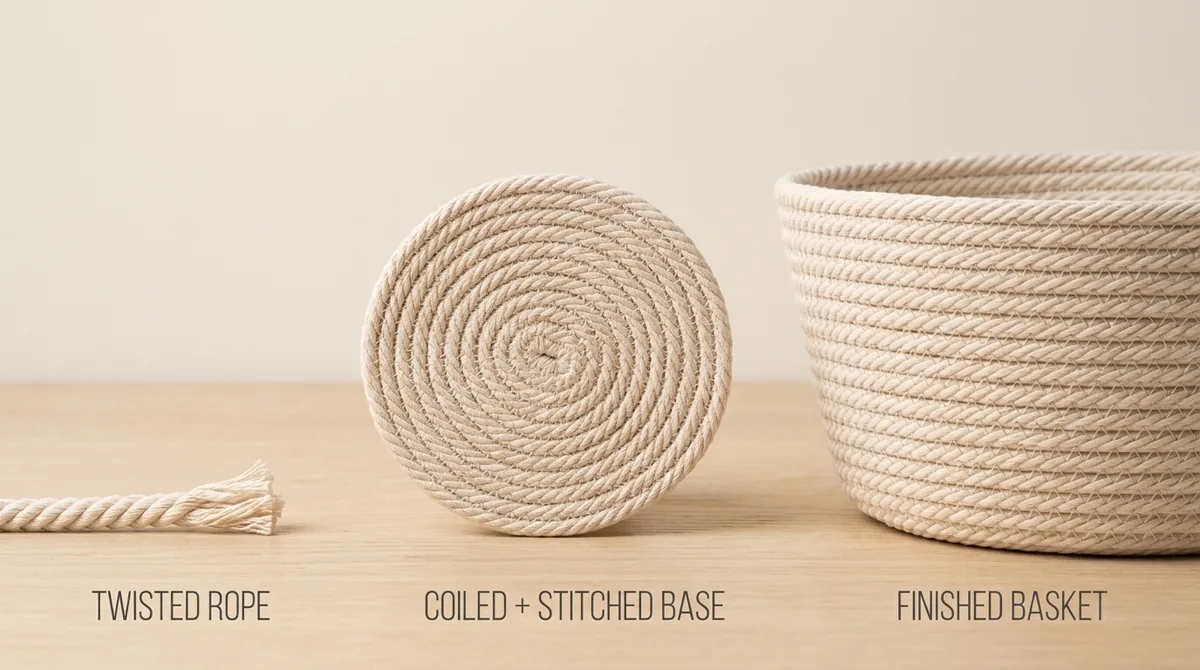
We make the rope first and the basket second: 3-10mm rope twisted or braided on our own machines, dyed to your shade, then coil-wound and zigzag-stitched into baskets with braided handles. The natural, undyed rope is cotton; every dyed shade is spun polyester, finished to look and handle like cotton — matte, soft, no synthetic sheen. Because the rope is ours, the shade is consistent from the base to the rim and repeat orders match the first one. Orders start at 5,000 pieces per size and shade, and quotes come back within one working day.
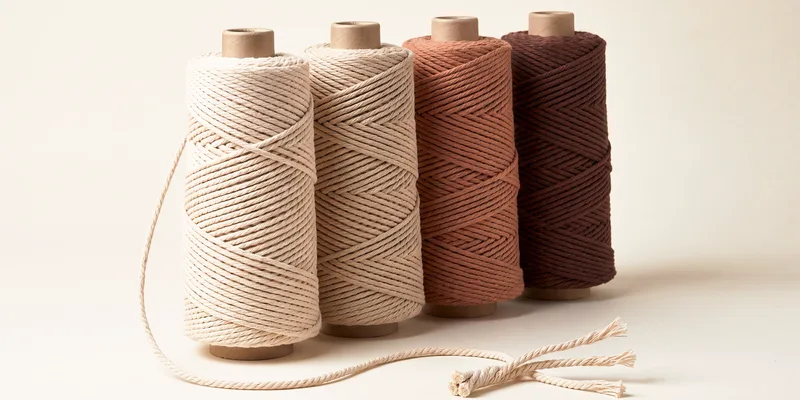
A rope basket is only as good as the rope inside it. Ours starts on our own twisting and braiding machines in Jaipur, is dyed on the same floor, and is then coil-wound and stitched into the basket body — so when you ask for the same grey twelve months later, we still have the rope spec and the dye recipe that made it. The natural, undyed rope is cotton; the dyed shades are spun polyester, finished matte and soft so they look and handle like cotton.
How the basket is built, starting with the rope
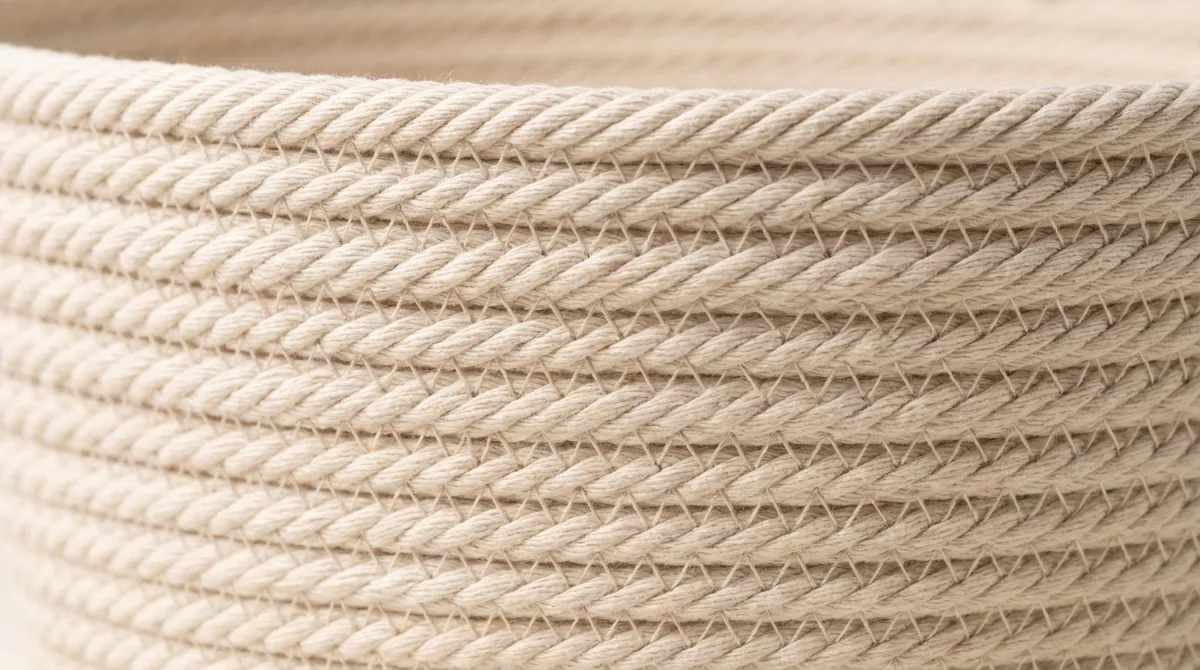
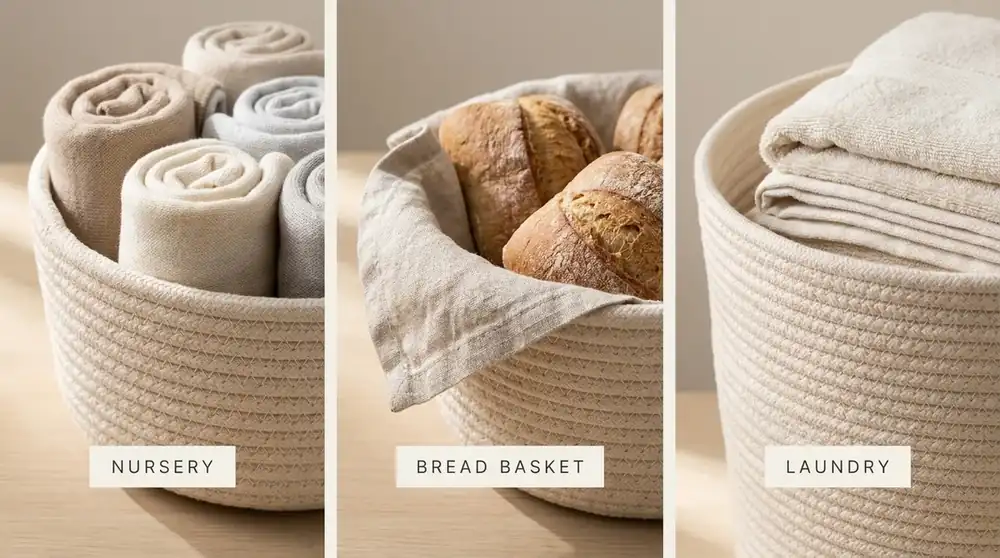
The rope. Ring-spun singles are plied on our frames, then either laid into 3-strand twisted rope or run through our braiding machines — cotton for the natural, undyed rope, spun polyester finished to a matte, cotton-like hand for the dyed shades. For basket work the useful range is 3mm to 10mm. Around 3-5mm gives a fine, tight coil with a lot of visible ridging — good for small storage bowls and nursery baskets. Around 6-10mm builds a chunkier, softer-walled basket that holds its shape better when it is empty and stacks well.
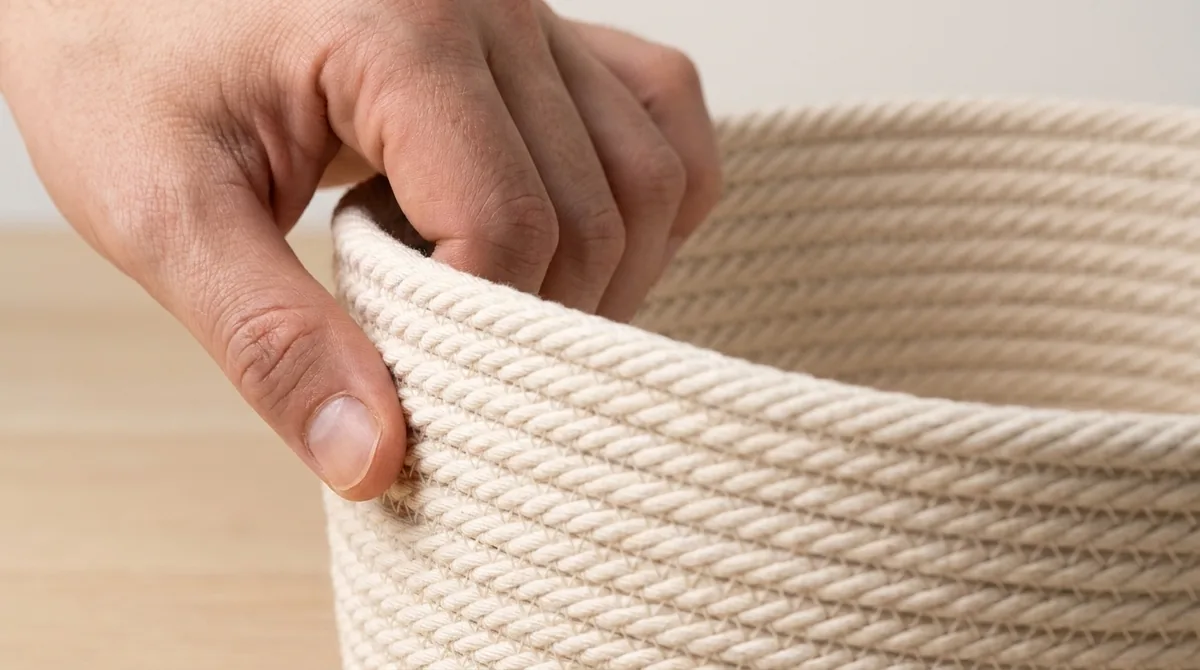
The body. The rope is coil-wound in a flat spiral for the base, then lifted into a wall, with each coil zigzag-stitched to the one beside it. Stitch density is a real spec: a tighter zigzag gives a stiffer, more upright wall, a more open one gives a slouchy basket that folds down. Tell us which behaviour you want and we set the machine to it.
The handle. Standard is a braided rope handle in the same rope as the body, stitched into the wall so the load pulls against the coil rather than a single seam. Cut-out side handles and rope loops are both possible on the same body.
What we do not do here is weave. This is coiled and stitched construction — if you want a hand-woven or crocheted basket, we are not the right factory.
Colour, and why in-house dyeing matters here
We dye the rope ourselves before it is wound into the basket. The dyed rope is spun polyester rather than cotton — it takes colour well, repeats shade-to-shade between batches, and comes back the same on a reorder. Natural undyed rope is the other standard option, and that one is cotton — a slightly warm off-white, which is not the same thing as bleached white, so say which one you mean.
We match against a physical swatch or a Pantone reference, send a lab dip for approval, and only then run bulk. Because one rope lot can supply a whole basket, you do not get the base-to-rim shade drift that shows up when a maker runs out of rope halfway.
If you are ordering a set of three sizes in one shade, ask for them to be cut from a single dye lot. It costs nothing and it removes the most common complaint about rope baskets — three baskets that are visibly not the same grey.
How wholesale buying works with us
Send sizes and a picture, not just a product name. Diameter and height in cm or inches, rope thickness if you know it, handle style, and how stiff you want the wall. A photo of a basket you already sell tells us more than a paragraph.
From 5,000 pieces per design, style or colour. One size in one shade counts as one line; a second size or shade carries its own 5,000. A first order is a single basket proven in your own channel before you widen the range.
Approve the lab dip and the sample basket. Colour on the dip, construction on the physical basket. Both before bulk starts.
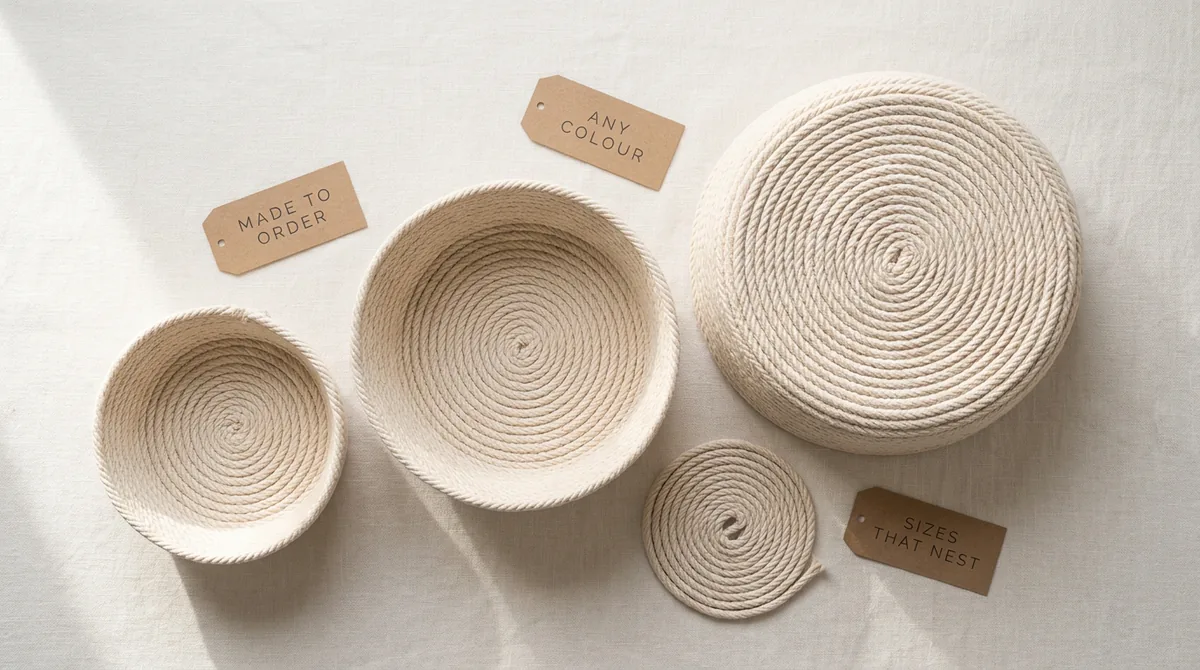
Fix nesting, packing and port. Sizes are set so they nest, cartoned for export. Tell us the destination port and we will say honestly whether air or sea makes sense at your volume.
Dispatch and freight
Ex-works Jaipur — about 2 to 6 days by surface across India. Freight is to your account, by your transporter or ours. Export orders are quoted separately with air and sea options.
Cotton Rope Storage Baskets, Coiled from Rope We Twist — Specifications
Material
Natural/undyed: ring-spun cotton. Dyed shades: spun polyester with a cotton-look matte finish and soft cotton hand. Both plied in-house before rope-making; other fibres to your specification at bulk volumes
Construction
Coil-wound rope body, zigzag-stitched coil to coil, with a braided rope handle stitched into the wall
Rope thickness
3mm to 10mm (3mm ≈ 1/8 in, 5mm ≈ 3/16 in, 6mm ≈ 1/4 in, 10mm ≈ 3/8 in); finer rope for tight small baskets, thicker for chunky self-supporting ones
Basket sizes
Made to your dimensions in diameter and height, in cm or inches; sizes set to nest for shipping
Colours
Natural undyed cotton as standard; dyed shades in spun polyester, matched in-house to your swatch or Pantone reference
Wall stiffness
Set by stitch density — tighter zigzag for upright walls, more open for a foldable basket
MOQ
5,000 pieces per design, style or colour
Put-up
Nested and cartoned for export; individual polybagging on request
In-house processes
Twisting, braiding, dyeing, coil-winding and stitching; weaving and crochet are not done here
Lead time
Quote within one working day; 7-10 days air or 25-40 days sea after sample approval
Origin
Jaipur, India
Frequently asked questions
What is the minimum order for wholesale cotton rope baskets?
Orders start at 5,000 pieces per design, style or colour — so 5,000 is one size in one shade, and a second size or shade carries its own 5,000. A first order is therefore a single basket proven in your own channel before you widen the range; a three-size set in one shade is three lines, 15,000 pieces. Bulk is quoted per size and shade, because both the machine setup and the dye lot economics change with quantity, and quotes come back within one working day.
What is the wholesale price of cotton rope baskets?
₹90-250 per piece ex-works Jaipur, at the 5,000-piece minimum. Size drives the spread: a small bread basket sits near ₹90 and a large laundry size near ₹250. The rope, the coiling and the stitching are all ours, so the quote holds on reorders.
Can you make baskets in my own sizes and colours?
Yes. Send diameter and height in cm or inches, the handle style you want, and either a physical swatch or a Pantone reference for colour. We dye the rope in-house, send a lab dip for approval, and make a sample basket before bulk. If you have an existing basket you want matched, post it to us — working from a physical reference is faster and more accurate than working from a photo.
Will the colour fade or rub off onto walls and shelves?
We dye the rope in-house before the basket is wound, so the shade runs consistently from base to rim rather than drifting partway up, and the dyed rope is spun polyester rather than cotton. Rather than make a claim you would have to take on trust, we send a finished basket in your shade before bulk — rub-test it against a light-coloured wall or shelf and wash-test it yourself, and approve bulk on what you find.
Are these woven or crocheted baskets?
Neither. The body is coil-wound rope, zigzag-stitched coil to coil on a machine, with a braided rope handle stitched in. That is a different look and a different price point from hand-woven or crocheted baskets, and it is what we are set up to do well. If your buyer specifically wants a woven or crocheted construction, we would rather tell you now than after a sample.
How do the baskets ship from India, and how do they pack?
Sizes are set so baskets nest inside each other, which keeps the cubic volume down — that is what decides your freight cost on a light, bulky product. Most US buyers air-freight two or three samples in 7 to 10 days, then ship bulk by sea in 25 to 40 days. Tell us your destination port and target arrival date and we will work backwards, including how the dye lot and the sailing need to line up.