Home › Cords & Ropes › Bakers Twine — Candy-Stripe, Twisted in Jaipur
Bakers Twine — Candy-Stripe, Twisted in Jaipur
✓ Specs last checked: 2026-09-02
We make wholesale bakers twine at our Jaipur factory by plying one pre-dyed coloured yarn against one bleached white yarn on our twisting frames, which is what gives the candy stripe its depth — the colour runs the full length of its own yarn rather than sitting on the surface of a finished cord. The dyed coloured yarn is spun polyester, finished to look and feel like cotton — matte, soft, no synthetic sheen; natural undyed yarn is cotton, and at bulk volumes other fibres can be run to your specification. We dye in-house in Jaipur, so a shade can be matched to your brand instead of picked off a stock card, and we wind to balls, spools or cones to suit your packaging. Trial orders start at 1,000 metres per colour and we ship worldwide.
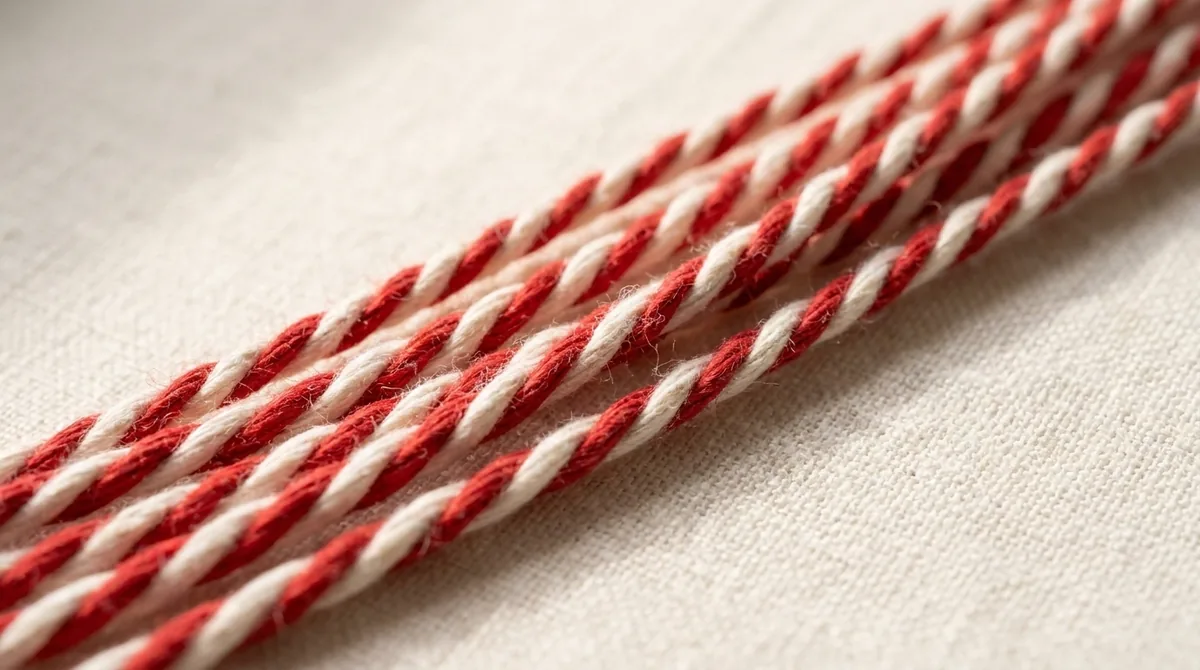
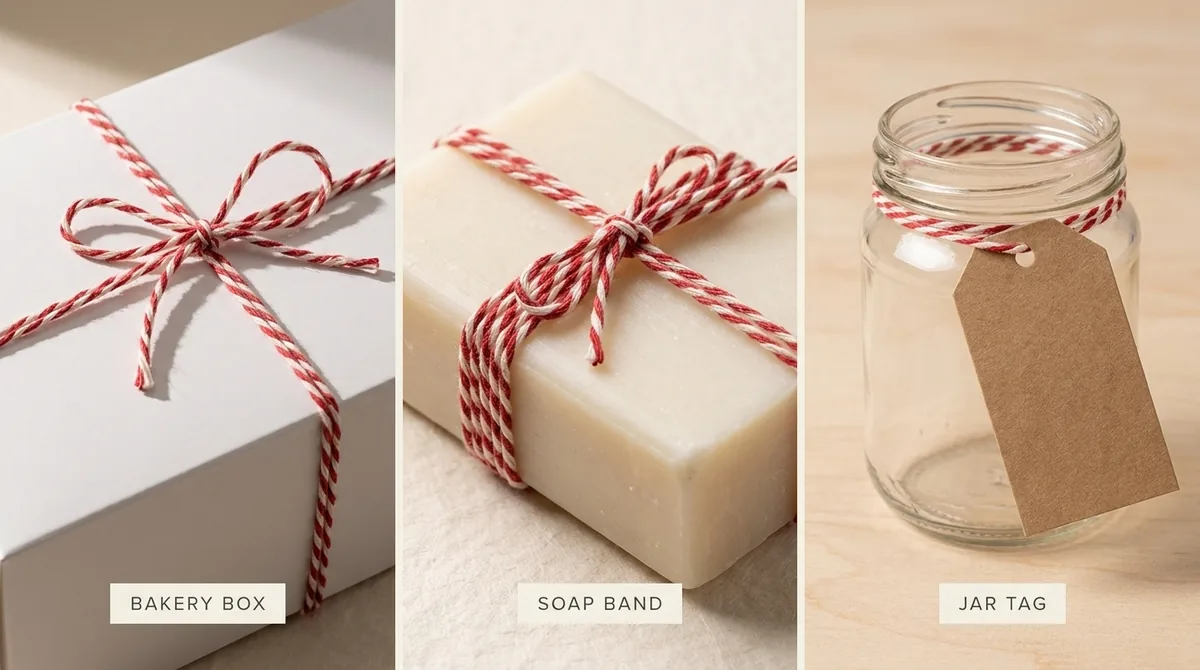
Bakers twine is the two-tone striped string that ties a pastry box, a bar of soap or a wedding favour. The stripe is not printed on. It comes from twisting a dyed coloured yarn together with a bleached white one, so the colour runs the full length of its own yarn and cannot rub off onto a customer's hands or a white gift box.
The dyed coloured yarn is spun polyester, finished to look and feel like cotton — matte, soft, no synthetic sheen. Natural undyed yarn is cotton, and at bulk volumes other fibres can be run to your specification. We dye the coloured yarn and ply it against white on our own frames, then wind it onto balls, spools or cones at whatever length your packaging calls for.
How Bakers Twine Is Constructed — Fibre, Ply and the Candy Stripe
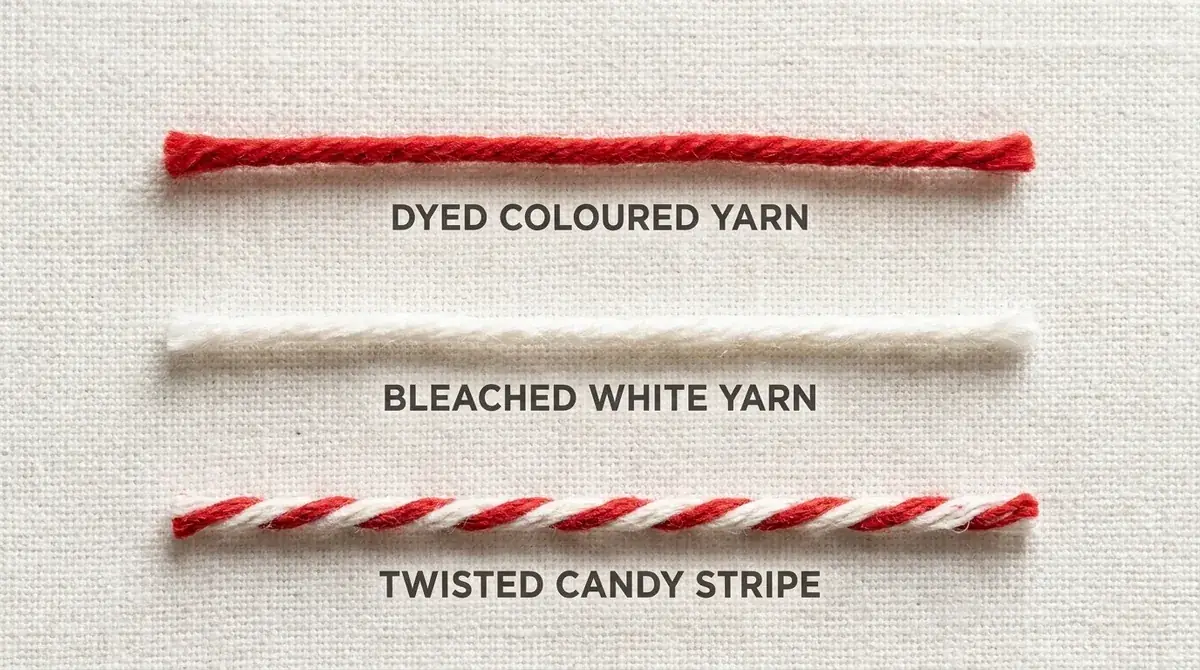
One lot of yarn goes into our dye house and comes out a solid colour — red, navy, kraft brown, sage, whatever the order calls for. Both yarns are spun polyester, finished to look and feel like cotton — one dyed to the colour, the other bleached to a clean white. Both are loaded onto the same twisting frames, and the twister plies one coloured yarn against one white yarn so they wrap around each other in a continuous spiral. That spiral is the candy stripe.
Because the stripe is structural, cutting the twine anywhere along its length still shows one coloured yarn and one white yarn in the cross-section. A printed or sprayed stripe sits on the outside of a cord, shows white at every crease and marks a pale box if it gets damp.
Ply count sets thickness. The basic unit is one coloured plus one white; feed more pairs into the twister and you get a heavier, rounder cord with the same stripe pitch. Roughly 1mm knots small and flat for bakery, tag and stationery work; around 2mm and up suits hampers, soap bands and jars. We set the twist tightness alongside the ply — a slack twist gives a softer, fatter cord, a firm twist a crisper, more defined stripe.
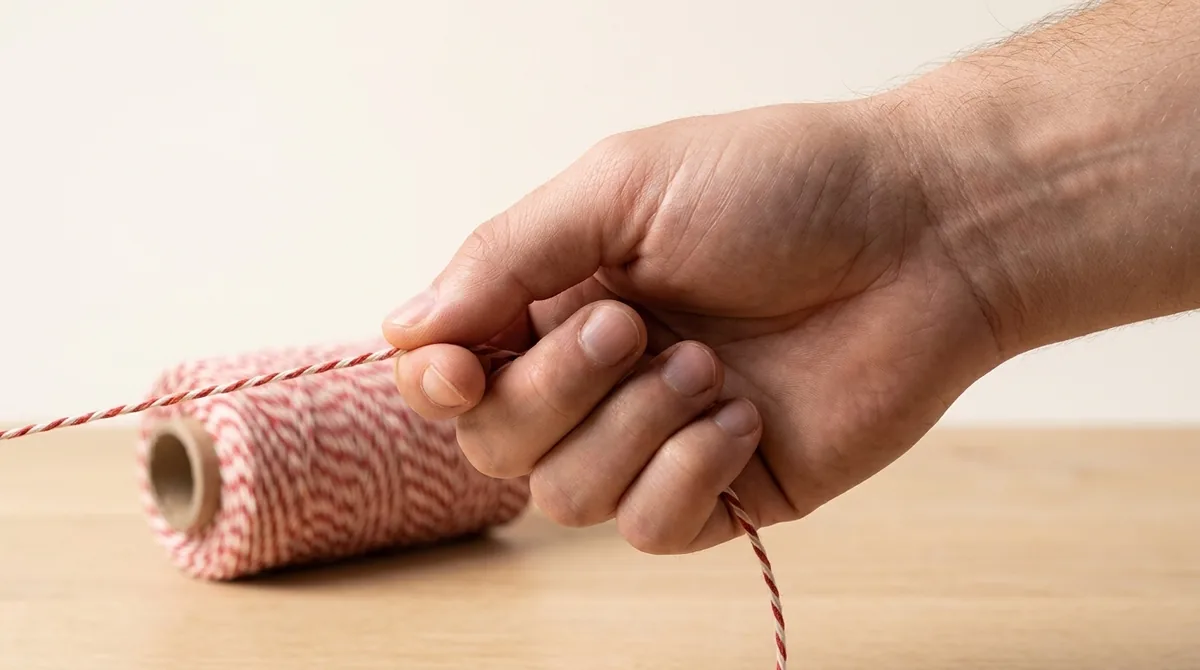
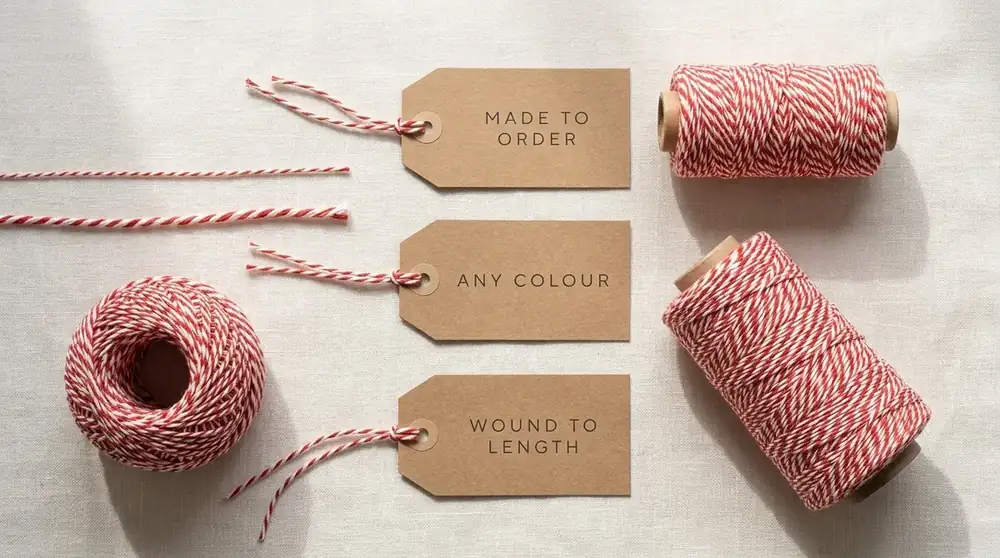
Balls, card spools, wooden spools, cones and industrial reels all come off the same twine on different winders. We agree the core, the length and the tension at quote stage so the twine feeds without collapsing and the put-up drops into your existing display or dispenser.
Bakers twine is a light decorative and packaging string. It is made to tie, bundle, hang a tag and finish a parcel — not to lift, hang weight, tow or take strain. If you need a cord that carries load, ask us about a rope or a heavier twisted cord instead. And if the twine will touch food directly rather than pass around the outside of a box or bag, tell us at enquiry stage so we can talk through an undyed white option before you order a dyed stripe.
How wholesale buying works here
Pick your colours, pick a thickness, pick a put-up, and start from 1,000 metres per colour. A SKU here means one combination of those three — red-and-white on a 20 metre retail spool and red-and-white on a 500 metre cone are two SKUs, because the winder is set up differently for each.
Send the colours, not the colour names — a Pantone reference, a fabric swatch or a physical piece of competing twine is worth more than any description in an email
Agree ply and thickness — tell us what it will be tied around and we will tell you which build sits right
Agree the put-up — spool or ball, core dimensions, metres per unit, and whether it needs to fit a display you already own
Trial run from 1,000 metres per colour — dyed and twisted on the same line that will run your bulk order
Bulk order at your volume — same twist setting, same shade batch reference held against your account
Air freight to the US runs roughly 7-14 days and sea freight roughly 25-40 days. If a shade is being matched for the first time, expect one round of a physical dye sample before the bulk run.
Colour matching and dye batches
Because we dye the coloured yarn ourselves rather than buying it in, a brand colour is a real option. Send a Pantone number or a physical swatch and we dye to it, and a lab dip goes back to you for approval before the bulk lot runs. We keep the recipe and the batch reference against your account and match to it on repeat orders. Do expect a small drift between dye batches — that is true of any dye house — so if shelf consistency across a whole season matters, order the season in one batch rather than in parts.
Dispatch and freight
Ex-works Jaipur — about 2 to 6 days by surface across India. Freight is to your account, by your transporter or ours. Export orders are quoted separately with air and sea options.
Bakers Twine — Specifications
Material
Coloured and bleached-white yarn: spun polyester, finished to look and feel like cotton. Natural undyed yarn: cotton. Other fibres to your specification at bulk volumes
Construction
Twisted candy stripe — pre-dyed coloured yarn plied against bleached white; no braiding
Sizes
Approx. 1mm to 2mm depending on ply count
Colours
Red-and-white classic plus full dyed range; brand colours matched to swatch or Pantone
MOQ
1,000 m per SKU, shade and size
Put-up
Balls, card or wooden spools, cones and reels — wound to your length and core
Packing
Spools, balls or cones packed in export cartons
Lead time
7-14 days air / 25-40 days sea to the United States
Origin
Made in Jaipur, India — dyed, twisted and wound in-house
Frequently asked questions
Will the colour bleed onto the white stripe or onto packaging?
Not in normal use. The colour is dyed into the coloured yarn before it ever reaches the twister, so it runs the full length of that yarn instead of sitting on the outside of a finished cord where it can rub off. Deep shades such as red and navy are always the ones to watch, so if your twine will be tied onto pale card or fabric and stored somewhere humid, ask for a trial length and test it against your own packaging before you commit.
What ply and thickness should I order?
Work backwards from what it is being tied around. Fine twine of roughly 1mm suits tags, invitations, favours and small pastry boxes — it knots flat and a bow stays neat at small scale. Heavier builds of around 2mm and up suit hampers, soap bands, jars and anything that needs visual weight in the hand. If you are unsure, order one fine and one heavy in the same colour on the 1,000 metre trial and tie them both around your actual product.
Can you match our brand colour?
Yes — we dye the coloured yarn in our own dye house in Jaipur, so shades are made to order rather than picked from a fixed stock list. Send a Pantone reference or, better, a physical swatch of the material you are matching. We dye a lab dip first for your approval, then hold the recipe and a batch reference against your account for repeat orders. The dyed coloured yarn runs in spun polyester finished to look and feel like cotton. Expect a small batch-to-batch drift, as with any dye house, and order a whole season together if exact shelf consistency is critical.
Can you wind onto our own spools or to a set length?
Yes, and it is worth settling at quote stage rather than after the first shipment. Send the spool or core dimensions, the metres per unit you want and, if you are replacing an existing supplier, a sample of the current put-up. We set the winder to match so your new stock drops straight into the display, dispenser or retail packaging you already use. We wind everything from short retail spools through balls to long cones and reels.
What is the minimum order, and how many colours can I test?
Trial orders start at 1,000 metres — about 1,094 yards — per colour, and there is no cap on how many colours you combine in one trial. Each colour carries the 1,000 metres in full, so four shades is 4,000 metres — worth knowing before you plan the order, because a shade that looks right on a screen often looks wrong tied around your actual packaging.
What does bakers twine cost wholesale?
₹3-8 per metre ex-works Jaipur. Single-colour twisted twine sits at the bottom of the band; two-tone candy stripe and custom-dyed shades sit higher because every colour is a separate dyeing run. Send the put-up you want — balls, spools or cones — and the quote comes back within one working day.
Is this the patli sutli used for gift and bakery packing?
Patli sutli — fine baker's twine — is this two-tone candy-stripe cord at roughly 1 mm to 2 mm, twisted in Jaipur for gift wrap, tags and bakery boxes. Colour combinations are made to order at 1,000 metres per SKU.